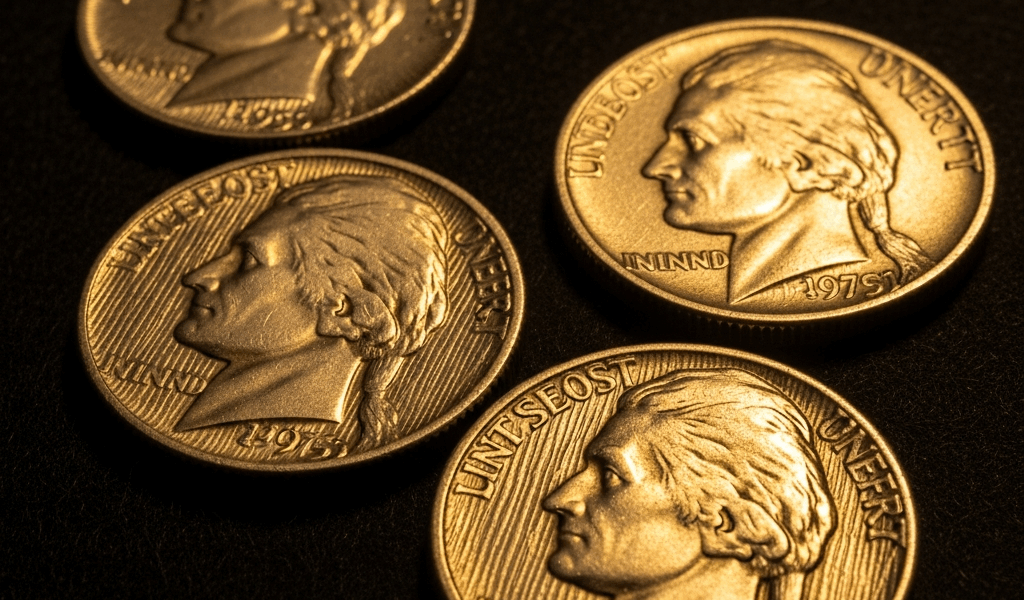
Jefferson Nickel War Time Alloy Varieties — Why These Five Years Matter More Than You’d Think
War nickel collecting has gotten complicated with all the misinformation flying around. As someone who spent three months treating 1942–1945 war-alloy pieces as filler between the “real” dates, I learned everything there is to know about this series the hard way. Today, I will share it all with you.
The moment it clicked for me: a dealer at a local coin show handed me a 1943-S — original gray toning, Full Steps reverse, the whole package — and I felt genuinely embarrassed. I’d been walking past these for a season. Don’t make my mistake. Jefferson nickel war time alloy varieties are not a footnote in some broader collection. They’re a distinct pursuit. They deserve dedicated research, specific storage knowledge, and a real appetite for die hunting that separates serious numismatists from casual type collectors.
These coins carry compositional differences that matter for preservation, mintmark placement patterns that rewrote U.S. coining practice, and enough die varieties to keep you returning to dealer tables for years. So, without further ado, let’s dive in.
Why the War Nickels Exist and What Makes Them Different
But what is a war nickel? In essence, it’s a five-cent piece struck between 1942 and 1945 using a silver-based alloy instead of the standard copper-nickel composition. But it’s much more than that.
Frustrated by critical nickel shortages threatening military equipment production, the U.S. Mint reformulated the five-cent piece mid-1942 using a blend of 35% silver, 56% copper, and 9% manganese — pulling nickel entirely from civilian coinage so it could be redirected to the war effort. That specific alloy looks different in hand. It tones differently. It strikes differently. An eighty-year-old war nickel sitting in a desk drawer looks nothing like a 1937-S kept under identical conditions.
The visual identifier everyone knows is that massive mintmark punched above Monticello on the reverse. Before 1942, Philadelphia struck nickels with no mintmark whatsoever. That changed permanently during the war years. A large P — or D or S, depending on origin — became the first mintmark ever to appear on a Philadelphia-struck nickel. That’s what makes the war nickel series endearing to us collectors. One policy decision handed the hobby a built-in historical marker you can read with your eyes.
The silver content matters, though not for melt value — 35% is too low to chase. It matters because the composition created genuinely different striking characteristics and preservation challenges. These are not standard nickels wearing a different uniform. They behave differently in albums, in flips, under loupes.
The 1942-P and 1942-D Transition Year Coins — Understanding the First Year
Nineteen forty-two is the year that built the subcategory. Philadelphia produced both regular-alloy nickels before the mandate hit and war-alloy nickels after. Denver did the same. San Francisco made only war-alloy pieces that year. This new production split took off several years later and eventually evolved into the complete war nickel series enthusiasts know and study today.
The practical distinction is straightforward enough. Regular 1942 nickels carry no mintmark (Philadelphia) or a small D (Denver). War-alloy 1942 nickels carry that oversized P or D above Monticello — and the large P is the one everyone talks about. First Philadelphia mintmark on a Jefferson nickel. Ever. Type collectors need it. Registry builders need it. Variety hunters need it because the mid-year transition created striking differences between early and late production runs.
I’m apparently an MS-63 buyer and buying raw from reputable dealers works for me while auction chasing never does. I paid $35 for a raw MS-63 1942-P from a dealer I trusted in 2019. Saw the same grade cross a major auction block for considerably more when original toning matched a clean provenance story. Circulated examples won’t hit your wallet hard. Original Mint State pieces — coins that genuinely never left bank rolls — are a different conversation.
Key Dates and Low-Mintage Strikes Worth Hunting
Probably should have opened with this section, honestly. The dates determine your hunting strategy more than anything else. High-mintage years mean you focus on die varieties and presentation quality. Low-mintage years mean you focus on locating the coin first, then worrying about strike.
The 1942-S war nickel: 32.9 million struck. Sounds comfortable. It isn’t. Weak reverses dominate this date — worn dies late in the year were the rule, not the exception. A sharp Full Steps 1942-S is genuinely difficult to locate.
The 1943-S: 15.3 million. Lower production compounded by consistent striking problems. San Francisco’s presses were running hard on nickels that year and quality control showed it. Expect weakness on both sides.
The 1944-D: 32.2 million. Worth hunting specifically because Denver struck it with die combinations that produced minor but catalogued varieties. More on that shortly.
The 1945-S: 58.8 million. Large numbers, but tougher in genuine Mint State than the mintage implies. Most circulated. When you find a clean MS-63 original, you’ve found something worth holding.
Die Varieties and RPMs Serious Collectors Target
This is where the war nickel series separates casual collecting from focused research. The 1943-P 3/2 overdate exists — the numeral 3 punched over a 2, documented in reputable variety catalogs, uncommon but not impossible to encounter at a dealer table or in an accumulation lot.
Repunched mintmarks run throughout the series. A 1944-D with a doubled or repunched D above Monticello has been catalogued by specialists who’ve spent years on this material. These varieties don’t command universal premiums — but they command real respect among war nickel specialists building registry sets focused specifically on these five years.
Full Steps designation from PCGS and NGC applies here with precision. To qualify, the staircase on Monticello’s reverse needs five or six fully separated, distinct steps — no merging, no flatness, no soft strikes bleeding details together. War nickels fail this test constantly because production demands and worn dies were endemic to the period. A 1942-P grading MS-64 with Full Steps is a substantively different coin from an MS-64 without it. In practice, I’ve seen Full Steps examples pull 20–30% premiums over identical numeric grades missing the designation. That gap is real.
The 1943-P shows up in every reputable die variety catalog worth owning. The 1944-D variations are worth documenting when you encounter them. The 1945-S repunched mintmarks exist — just not as extensively catalogued as other dates in the series.
How to Store and Present War Nickels in a Collection
While you won’t need a climate-controlled vault, you will need a handful of quality archival supplies. That 35% silver composition tones differently than standard copper-nickel — developing gray, tan, and sometimes iridescent purple coloring when stored properly over decades. This is not damage. This is provenance. Clean a war nickel and you erase eighty years of history. Don’t do it.
Archival 2×2 flips — Lighthouse or Intercept Shield specifically, running about 15–30 cents per flip depending on quantity purchased — are the correct choice. Standard PVC flips leach into surfaces and produce green spots. I know this because I ruined exactly one war nickel using dollar-store flips I bought in 2015. Seven dollars of savings cost me a coin I’d paid $22 for. Don’t make my mistake.
First, you should assess presentation goals — at least if you want your storage method to match your collecting ambitions. Album pages work well for access and visual inspection. Slabs make sense if you’re building a registry set or if the coin grades MS-65 or higher. For a working raw collection, proper flips in a sorted cigar box — organized by date and mintmark — give you flexibility and keep coins safe from casual handling.
The series is approachable. A basic date set covering 1942–1945 runs under $100 in circulated grades. Hunting varieties and die markers adds maybe another $150 to the project. Building a Mint State registry in certified slabs is an option if competition interests you. The war nickel series rewards whatever attention level you bring to it. Start somewhere reasonable — the rest follows naturally.


Stay in the loop
Get the latest global coin collector updates delivered to your inbox.