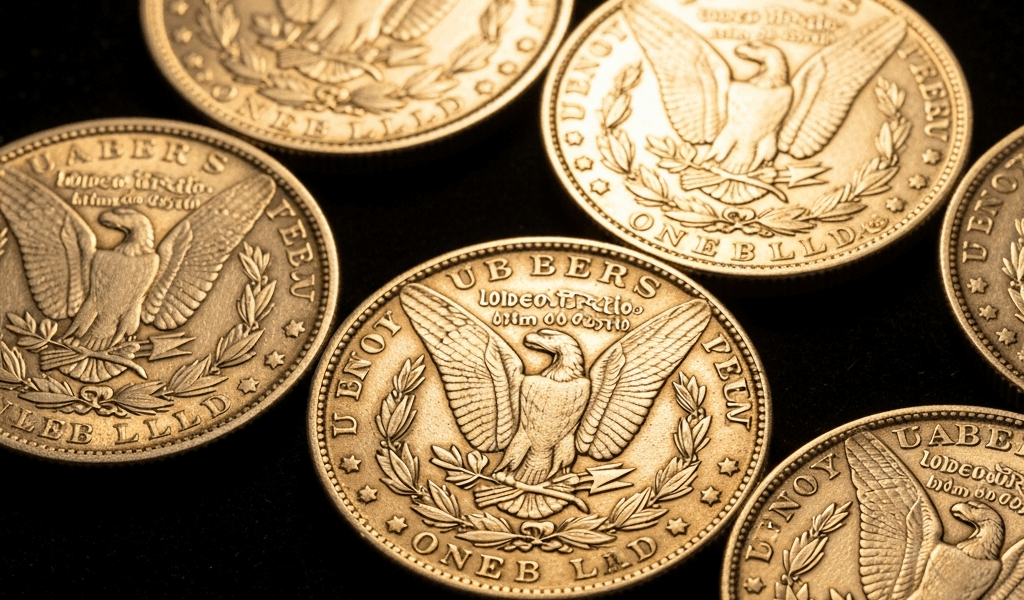
What Makes a Morgan Dollar a VAM Worth Hunting
Morgan dollar collecting has gotten complicated with all the misinformation flying around about what VAMs actually are and whether they’re worth chasing. So let me clear it up. VAM stands for Van Allen-Mallis — John Van Allen and George Mallis catalogued these die varieties starting in the 1970s. In essence, they’re the fingerprints left behind when a die gets repunched, tilted, clashed, or doubled during the minting process. But it’s much more than that.
Most collectors assume VAMs are invisible without expensive lab equipment. They’re wrong. Plenty of VAMs sit in circulated coins inside dealer bins right now — a doubled mintmark here, a lip that looks like it’s grinning, a date punched slightly off-center. A 10x loupe and decent lighting catch them. That’s it.
Here’s the distinction that tripped me up early on: VAMs aren’t mint errors in the dramatic sense. They’re die states. Every coin struck from a specific die carries the same VAM designation — permanently. That’s what makes systematic date-based hunting so logical. Certain years and mint facilities produced dies with detectable, collectible variations that survived in the wild, and they’re still out there.
1881-S VAM-1 and the Mintmark Tilts Worth Spotting
Probably should have opened with this section, honestly. The 1881-S is the practical starting point if you want to hunt VAMs without feeling like you’re drowning. High mintage — 5.7 million coins. Widely circulated. Affordable in Good to Very Fine condition, usually $35–$60 depending on the dealer. And VAM-1 covers mintmark tilt variations that are genuinely visible to the naked eye under magnification.
San Francisco mint dies in 1881 had the S mintmark punched at different angles. Some tilted left. Some right. Some straight. These weren’t mistakes exactly — just how dies wore and got re-punched over time. VAM-1 specifically refers to the rightward tilt, the most common one.
Grab a 10x loupe. Anything under $15 works fine — I use a cheap Belomo that cost me $12 off Amazon and it’s never let me down. Find the mintmark on the reverse, below the eagle, left side of the wreath. Now tilt the coin under a raking light — light hitting the surface at a sharp angle, not straight down. The tilt becomes obvious fast. You’re not hunting damage. You’re reading the angle at which the punch struck the blank.
Why start here? Because 1881-S Morgans flood the market. Pull three or four coins from any dealer’s $20–$40 circulated bin and you have a real shot at a VAM-1. That early success matters. It proves the hunt actually works, which keeps you going.
1884-O VAM-4 Hot Lips and Why It Stays Popular
The 1884-O Hot Lips is the celebrity of Morgan VAMs. Not rare. Not expensive. Just visually striking — and the story behind it explains how die varieties form in ways that actually stick in your memory.
A die clash happens when two dies collide inside the press with no blank between them. The upper die, carrying Liberty’s portrait, slams into the lower die showing the eagle. They meet. The impact leaves impressions — each die picks up fragments of the other’s design. Every coin struck afterward carries those ghost impressions.
On the 1884-O Hot Lips, the clash landed right on Liberty’s mouth. She looks like she’s pouting — exaggerated lip, slightly theatrical. VAM-4 is the specific designation. Not damage to the coin itself. A permanent mark burned into the die that transferred to every single coin it struck afterward. That’s what makes it endearing to us VAM hunters.
Finding one in circulated condition is realistic. New Orleans produced these heavily that year, and Fine to Extremely Fine examples show up regularly. The extra lip detail survives moderate wear because the clash struck deep into the die’s surface — it wasn’t a glancing blow.
I had to learn this the hard way: a weakly struck normal impression looks fuzzy and faint, edges undefined. A die clash looks almost intentional — cleaner edges, defined lines, like something was added to the design rather than worn away. Spend ten minutes comparing a known Hot Lips photo from VAM World to a regular 1884-O Liberty face and the difference clicks. Don’t make my mistake and spend forty-five minutes second-guessing a coin that turned out to be just worn.
1896-O and 1899-O Mintmark Varieties to Compare
New Orleans Morgans from the 1890s are the unsung hunting ground. Repunched mintmarks everywhere — and most collectors walk right past them. A repunched mintmark happens when the die punch misses, gets repositioned, and strikes again. The result is two O’s, one offset from the other, sometimes clearly, sometimes subtly.
The 1896-O carries multiple VAM designations tied to O/O repunches in slightly different positions. Same story with the 1899-O. Neither date is expensive. Neither is rare. But if you own a handful of New Orleans Morgans from these years, odds genuinely favor finding a repunched variety hiding in plain sight.
Here’s the distinction worth drilling into your head: a filled mintmark looks soft and shallow — wear smoothed it down, edges gone. A repunched mintmark looks doubled, shows an offset impression, reveals partial strikes that wear couldn’t fully erase. Look at the bottom of the O specifically. Does it have a shadow below it, like another O started forming but stopped? That’s often a repunch.
I spent an afternoon comparing three 1899-O coins against a reference photo, convinced I’d found something significant. Two turned out to be normal strikes. The third had a clear second O partially visible at the base — shadow distinct, offset maybe 0.5mm. That’s the coin that went into the log. That’s the hunt paying off, even if it took a few hours to get there.
Why compare these two dates side by side specifically? Because most collectors already own several New Orleans coins from the 1890s. Having a targeted comparison list gives you a reason to pull them from the box, examine them systematically, and actually document what you own rather than guessing.
How to Start a Working VAM Checklist for Your Collection
VAM World is the reference standard. Free. Online. Search by date and mint, get VAM designations, die characteristics, and comparison photos. Bookmark it today — it’s the only database you actually need.
While you won’t need an elaborate photography setup or a digital microscope, you will need a handful of basic tools. A 10x loupe runs $10–$30. A small LED flashlight or headlamp costs around $15 — I’m apparently particular about lighting and a $14 Coast HP1 headlamp works for me while my old desk lamp never did. One known VAM coin for side-by-side comparison rounds out the kit. That’s the entire investment.
Keep a simple log — date, mint, grade, VAM designation, where you found it, what you paid. A spreadsheet works fine. A paper notebook works fine. The point isn’t building an investment tracker. It’s building knowledge through documentation. You start recognizing patterns fast once you’re writing things down consistently.
Join the communities doing this work. The Morgan Dollar Variety Club meets regularly. Reddit’s r/coins and several VAM-specific Facebook groups have thousands of people examining the same coins, posting the same questions. Post your finds. Ask whether that shadow on your 1899-O is a repunch or just wear. You’ll get honest answers quickly — these communities genuinely reward curiosity over profit motive.
The real payoff isn’t resale value. It’s the moment you spot a doubled die under your loupe and recognize it instantly — without checking the book first. You’ve found proof that a coin spent 140 years in the world, and you’re the one who finally saw it clearly. That discovery stays with you in a way a graded slab in a plastic holder never does. That’s why VAM hunting beats buying slabs.



Stay in the loop
Get the latest global coin collector updates delivered to your inbox.