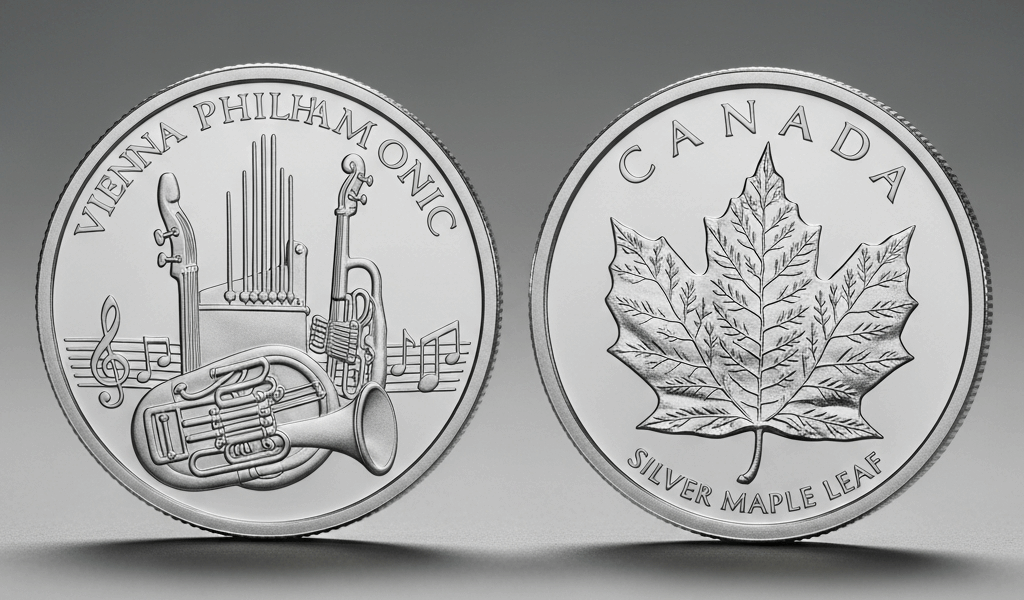
Vienna Philharmonic vs Canadian Silver Maple Leaf — Which World Silver Coin?
The silver Philharmonic vs Maple Leaf debate comes up constantly in collector forums, and after years of buying both — I once accidentally ordered a full tube of Philharmonics when I meant to reorder Maple Leafs, which turned into an accidental education — I’ve developed strong opinions about where each coin actually earns its place. These are two of the most recognized silver bullion coins on the planet. They share almost nothing in common beyond the 1 troy oz weight and roughly similar premiums over spot. The coin you should buy depends almost entirely on where you live, what you’re building, and how you think about silver.
Quick Comparison
Before getting into the origin stories and collector angles, here’s how these two coins stack up side by side on the specifications that actually matter at the point of sale or trade.
| Feature | Vienna Philharmonic | Canadian Maple Leaf |
|---|---|---|
| Issuing Mint | Austrian Mint (Münze Österreich) | Royal Canadian Mint |
| Silver Purity | .999 fine silver | .9999 fine silver |
| Weight | 1 troy oz (31.10g) | 1 troy oz (31.10g) |
| Face Value / Currency | 1.50 Euro (legal tender, Austria) | 5 CAD (legal tender, Canada) |
| Design History | Single design since 1989 | Core design since 1988, annual security feature updates |
| Security Features | None beyond standard minting | Radial lines, laser-engraved maple leaf, DNA anti-counterfeiting |
| Typical Premium Over Spot | $3.00–$4.50 per oz (dealer dependent) | $3.50–$5.00 per oz (dealer dependent) |
| Market Recognition | Strong in Europe, moderate elsewhere | Strong globally, particularly North America and Asia |
That .9999 vs .999 purity difference doesn’t translate to a dramatic price gap day-to-day. At spot around $28/oz as of mid-2024, the actual silver content difference is fractions of a cent. It matters more as a marketing signal and in niche refining contexts than it does in your actual stack value.
The Vienna Philharmonic — Music, Euros, and 35 Years of One Design
The Austrian Mint introduced the Vienna Philharmonic in 1989, originally denominated in Austrian Schillings before the Euro conversion in 2002 changed the face value to 1.50 EUR. That transition is interesting because the coin didn’t change — only the currency stamped on it did. The Münze Österreich made a deliberate choice to keep the design locked. No annual variations. No commemorative editions bleeding into the main lineup. Just this one design, minted consistently for over three decades.
The obverse shows the Great Organ of the Musikverein, Vienna’s famous concert hall where the Vienna Philharmonic Orchestra performs its New Year’s Concert every January. The reverse features a grouping of instruments — a cello, four violins, a Vienna horn, a bassoon, and a harp. These are not generic musical decorations. They are specific instruments associated with the actual orchestra. The detail in the engraving is exceptional, particularly on early strikes where the die quality was at its peak.
Why one design for 35 years? It’s a philosophical statement about the coin’s identity. The Austrian Mint wants the Philharmonic recognized the same way you recognize a specific painting — you see it once, you know it forever. Struck by a desire to build a set that had visual coherence across multiple years, many European collectors specifically gravitate toward this coin over alternatives precisely because a tube of 20 Philharmonics from 1993 looks identical to one from 2023. That kind of design continuity is almost impossible to find in bullion coinage.
The coin is also, practically speaking, the dominant silver bullion coin in the European market. Dealers in Germany, Austria, Switzerland, and the Netherlands keep Philharmonics in stock the way North American dealers keep Maple Leafs. When you’re buying or selling within Europe, you’re working within an ecosystem that prices and recognizes this coin immediately. That liquidity matters more than most new buyers realize.
The Canadian Maple Leaf — .9999 Fine Silver and Annual Security Updates
The Royal Canadian Mint launched the Silver Maple Leaf in 1988, one year before the Philharmonic. The core design — the stylized sugar maple leaf on the reverse, Queen Elizabeth II (now King Charles III) portrait on the obverse — has remained consistent. What has changed, dramatically, is the security infrastructure underneath that design.
Here’s the year-by-year evolution that most buyers don’t fully appreciate:
- Pre-2014: Standard radial line background, no laser features
- 2014: Laser-engraved micro maple leaf security mark introduced (visible under magnification, typically positioned at the 8 o’clock position on the maple leaf)
- 2015: Bullion DNA anti-counterfeiting technology added — a scannable feature embedded during striking that allows Royal Canadian Mint authorized dealers to verify authenticity
- 2018 onward: Continued refinements to radial line precision and edge lettering
The .9999 purity is a genuine differentiator in some contexts. When selling to refiners, the four-nines standard simplifies their process. Internationally — particularly in Asian markets where purity standards are scrutinized closely — the .9999 stamp carries real marketing weight. Japan and Hong Kong buyers have historically shown preference for four-nines silver over three-nines when both are available at similar premiums.
One thing I learned the hard way: earlier Maple Leafs (pre-2014 especially) are notoriously prone to milk spots — white, hazy patches that develop over time even in properly stored coins. It’s an oxidation issue tied to the high purity of the silver reacting with residual moisture during minting. The Royal Canadian Mint has worked to reduce this with improved handling processes, but it’s still a real consideration if you’re buying for numismatic condition rather than pure bullion weight.
Probably should have opened with this section, honestly, because the milk spot issue is the first thing experienced collectors ask about when someone mentions Maple Leafs — and new buyers are almost always blindsided by it when they pull a stored coin out and find spots on what they thought was pristine silver.
Which Is More Valuable on the Resale Market
Geography determines this answer. Full stop.
In Europe — Germany, Austria, the Netherlands, Belgium, Scandinavia — the Philharmonic commands strong liquidity. Local coin dealers know the coin, price it quickly, and have existing buyer networks. The European Central Bank recognition of the Euro face value adds a legal tender layer that matters in certain dealer relationships. Trying to sell a tube of Maple Leafs at a small coin shop in Munich is possible but slower, and you may lose a point or two on the spread compared to selling Philharmonics.
Flip that scenario to Toronto, Vancouver, Chicago, or Houston, and the Maple Leaf wins decisively. Every APMEX order, every local coin show, every dealer network in North America treats the Maple Leaf as a baseline reference coin the same way they treat the American Silver Eagle. Philharmonics are known and tradeable, but they’re the slightly exotic option that requires a moment of explanation at some shops.
Asia is interesting. Both coins trade there. The Maple Leaf’s .9999 purity gives it an edge with buyers who prioritize purity signaling, and the Royal Canadian Mint has done significant distribution work in Hong Kong and Singapore. The Philharmonic has a following among European expat communities and some collectors who specifically seek the Euro denomination connection, but it’s not the dominant world coin in Asian bullion markets.
Globally, the Maple Leaf’s distribution infrastructure is broader. That’s just the reality of RCM’s decades of international dealer relationship building.
Which Is Better for a World Silver Coin Collection
This is where personal collecting philosophy actually separates the two coins more sharply than any specification sheet.
The Philharmonic is the coin for collectors who value thematic depth in a single design. Building a complete date run from 1989 through today, every coin looks essentially the same — but that’s the point. The satisfaction is in the completeness, the historical span, the idea of holding Austrian cultural identity expressed consistently across decades. The music theme resonates strongly with collectors who have a connection to classical music, European culture, or the specific story of the Vienna Philharmonic Orchestra itself.
The Maple Leaf is the coin for collectors who find the technical evolution interesting. The security feature progression year-over-year gives collectors something to study and compare. Early issues versus later DNA-authenticated strikes tell a story about the Royal Canadian Mint’s response to counterfeiting pressures — a story that is actually fascinating once you start reading about it. The condition challenge posed by milk spots adds a layer of grading knowledge that some collectors find genuinely engaging rather than frustrating.
For a world silver coin collection specifically — a collection meant to represent national mints and sovereign issues from different countries — you arguably want both. The Philharmonic represents the eurozone and Austria’s extraordinary classical music legacy. The Maple Leaf represents Canada and the Royal Canadian Mint’s engineering-forward approach to bullion. They tell different national stories through the same 1 troy oz format.
The Verdict — European Collector vs North American Market
Here’s the direct answer without qualification:
Buy the Vienna Philharmonic if you are based in Europe, plan to sell within European dealer networks, value design consistency and cultural meaning over technical security features, and want a coin with genuine European market liquidity. The Philharmonic is also the better choice if you’re building a collection specifically organized around cultural or artistic themes — this coin has a story that goes beyond the silver content.
Buy the Canadian Maple Leaf if you are in North America or planning to sell into North American or Asian markets, you care about the highest available purity (.9999), you want annual security feature updates as part of your collecting interest, and you value the broadest possible global dealer recognition. For straightforward bullion accumulation with maximum resale flexibility, the Maple Leaf is the more practical choice in most markets outside Europe.
Neither coin is wrong. Both are legitimate, well-struck, sovereign-issued 1 oz silver coins from mints with centuries of combined history. The Austrian Mint dates to 1194. The Royal Canadian Mint opened in 1908. You’re not choosing between quality — you’re choosing between identities, markets, and collecting philosophies. Know which one you’re actually optimizing for, and the decision becomes obvious.

Stay in the loop
Get the latest global coin collector updates delivered to your inbox.