South African Krugerrand vs Canadian Gold Maple Leaf — Which to Collect?
The krugerrand vs canadian maple leaf debate has gotten complicated with all the investment noise flying around. Spot premiums, liquidity ratios, portfolio percentages — that’s the framework most articles use, and honestly, it misses the point entirely if you’re a collector rather than a trader. As someone who’s been handling world coins since the late 1990s, I learned everything there is to know about both of these coins the hard way — starting with a battered 1979 Krugerrand I picked up at a flea market outside Pretoria for 1,850 South African rand, which felt like highway robbery at the time. The collector’s case for each coin runs completely separate from the investor’s case. Different enough that your answer changes depending on who you actually are.
Let me walk you through both coins the way a collector thinks — varieties, presentation, history, the feel of the thing sitting in your palm.
Quick Comparison
Before getting into the details, here’s a side-by-side look at the core specs. Purity and mintage figures affect numismatic value directly, so even pure collectors need to know these numbers.
| Feature | Krugerrand | Canadian Maple Leaf |
|---|---|---|
| Gold Purity | 91.67% (22-karat) | 99.99% (24-karat) |
| Gold Weight (1 oz) | 1 troy oz gold content | 1 troy oz gold content |
| Total Coin Weight | 33.93 grams | 31.15 grams |
| Annual Mintage (approx.) | Varies — no face value limit | Varies — typically 500,000–1M oz |
| Average Dealer Premium | 3–5% over spot | 4–6% over spot |
| Global Recognition | Extremely high — 50+ years | Very high — especially North America |
| Proof/Numismatic Editions | Yes — limited annual proofs | Yes — extensive annual program |
That purity gap is the first thing splitting collectors from investors. A fine-gold purist zeros in on that 99.99% figure immediately. A history-focused collector zeroes in on the Krugerrand’s 1967 origin story instead. Both instincts are right — they’re just answering different questions.
The Krugerrand — 91.7% Pure Gold, Maximum Recognition
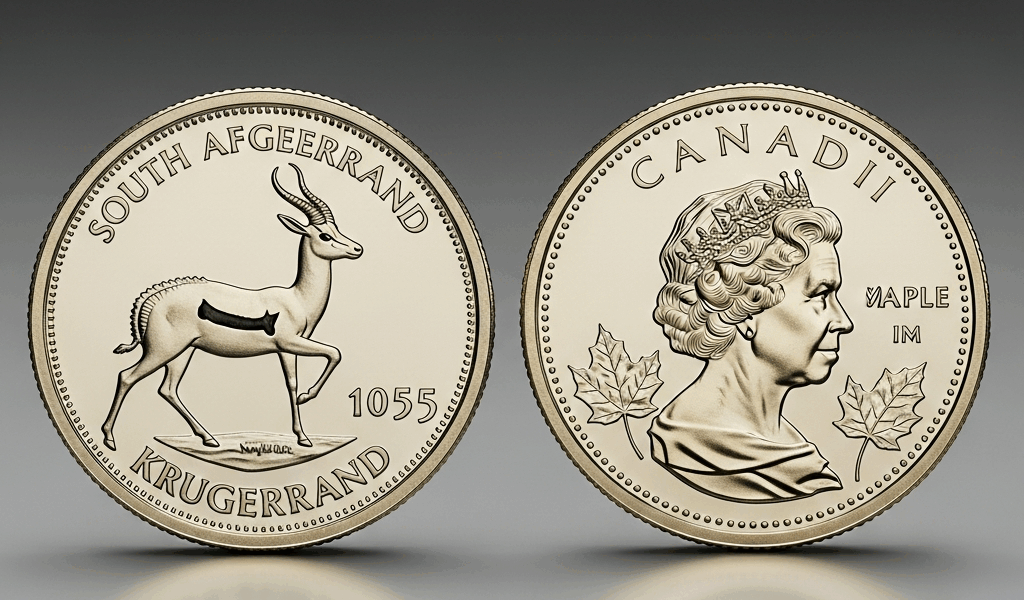
But what is the Krugerrand, really? In essence, it’s a 22-karat gold bullion coin minted in South Africa since 1967. But it’s much more than that — it’s the coin that essentially invented the modern gold bullion market as a concept. Before it existed, owning investment gold meant hoarding bars or pre-1933 American coins. The South African Mint released it specifically to move South African gold into private hands worldwide. Paul Kruger’s portrait — former president of the South African Republic — sits on the obverse. A springbok antelope occupies the reverse. Sculptor Coert Steynberg designed both images, and the springbok detail especially holds up beautifully against anything being minted today.
The 22-karat alloy — 91.67% gold, 8.33% copper — gives the coin its distinctive rose-gold warmth. That copper content also makes it substantially harder and more scratch-resistant than pure-gold coins. I dropped my 1983 Krugerrand on a tile floor once. The coin was fine. My nerves took considerably longer to recover.
The Apartheid Ban — Why It Matters to Collectors
Probably should have opened with this section, honestly. The ban period is the single most interesting numismatic story either of these coins carries, and investment articles almost never mention it.
During the 1970s and especially through the 1980s, the Krugerrand was banned for import across the United States, the UK, and most of Western Europe — anti-apartheid sanctions that ran from roughly 1985 to 1994 in America. Coins minted through those years carry a specific collector narrative. They moved through grey markets. Dealers held them in Geneva and Hong Kong. The provenance history on a mid-1980s Krugerrand is genuinely unusual — it’s not just a bullion coin. A 1986 strike is a document of a specific political moment, handled by specific people trying to work around specific geopolitical pressure. That’s what makes the Krugerrand endearing to us history-focused collectors. No spreadsheet captures it.
Krugerrand Proof Editions
The South African Mint has issued proof Krugerrands since 1967 — often in presentation sets with serialized certificates. The 50th anniversary proof set from 2017, packaged in a burgundy leatherette case, is a genuinely stunning piece. Many proof years saw mintages under 10,000 total. The 1oz proof Krugerrand — frosted devices against a deep mirror field — looks nothing like the standard bullion strike. Completely different experience holding it.
The Canadian Maple Leaf — 99.99% Pure Gold, Better Numismatic Variety
The Royal Canadian Mint released the Gold Maple Leaf in 1979 — partly, apparently, as a direct response to growing international discomfort with buying South African gold. Frustrated by that political friction in global gold markets, Canada leveraged its own enormous reserves and considerable goodwill to launch a competitor. The result was a coin that immediately pushed on purity: 99.9% at launch, upgraded to 99.99% by 1982. The maple leaf reverse is clean and iconic — recognizable on a shelf in Tokyo or Frankfurt just as easily as in Toronto.
This new idea took off several years later and eventually evolved into the collector series enthusiasts know and chase today. I picked up a 2010 proof Maple Leaf at a coin show in Ottawa in 2011 — still in its Royal Canadian Mint presentation case, sitting under a dealer’s glass counter next to a row of circulated silver dollars. The frosting on that maple leaf design under a loupe stopped me cold. Made me genuinely reconsider which coin I thought was more collectable.
Security Features and Annual Design Changes
Starting in 2013, the Royal Canadian Mint laser-engraved a security mark directly into bullion Maple Leafs — a radial line field pattern plus a micro-engraved maple leaf privy mark visible at 10x magnification. By 2015, they’d added a DNA anti-counterfeiting system tied to a secure database. These aren’t marketing gimmicks. They make high-quality counterfeiting genuinely difficult — the kind that fools experienced dealers.
For collectors, the annual privy mark variations are the real draw. The 2014 Horse privy. The 2019 First Moon Landing anniversary edition. Various fractional sets running back through the 1980s. The Royal Canadian Mint runs an aggressive numismatic program — volume and consistency the South African Mint simply doesn’t match.
Fractional and Specialty Sets
While you won’t need every denomination, you will need a handful of key years if you’re building a serious Maple Leaf collection. Standard annual releases cover 1/20 oz, 1/10 oz, 1/4 oz, 1/2 oz, and 1 oz. The Royal Canadian Mint also issues five-coin proof sets in presentation folders — retail around CAD $2,400 for current proof strikes. Secondary market demand on these sets is real. Finding a complete run of proof Maple Leaf sets from 1989 forward is a legitimate collecting goal with genuine numismatic depth behind it.
Which Is Worth More as an Investment
Short answer — close enough that it rarely matters for a buy-and-hold position. Both trade near spot with a 3–6% dealer premium depending on order size. APMEX typically prices standard bullion Maple Leafs about 1–2% above equivalent Krugerrands — reflecting the higher fabrication cost of 99.99% refining. JM Bullion and SD Bullion run similar spreads.
Resale liquidity is genuinely global for both coins. Walk into a dealer in Dubai, Frankfurt, or Tokyo with either one and you’ll get a quote on the spot. The Krugerrand probably edges out the Maple Leaf across Africa, the Middle East, and parts of Europe where 50-plus years of circulation built deep familiarity. The Maple Leaf holds a stronger position in North America and Asia-Pacific markets where Canadian mining reputation carries actual weight with buyers.
Don’t make my mistake. I sold a group of 1980 Krugerrands in 2008 at a moment when the apartheid-era provenance premium was real — and I didn’t recognize it. Got spot plus 4%. A specialized numismatic buyer would have paid considerably more. Know your buyer before you sell. General bullion dealers and numismatic specialists are two entirely different conversations.
Which Is Better for a World Coin Collection
This is where the answer diverges hard from anything the investment analysis tells you.
The Maple Leaf might be the best option for depth-focused collectors, as serious numismatic building requires consistent annual variety. That’s because the Royal Canadian Mint simply outpaces the South African Mint in sheer program volume — more proof editions, more specialty packaging, more privy mark variants, more fractional sets, year after year. The 1994 Maple Leaf had a 1 oz bullion mintage of approximately 104,788. The 1998 edition came in around 70,000. These numbers matter to set builders hunting for genuine low-mintage years within an ongoing series.
The Krugerrand wins on historical weight. No modern bullion coin carries the political, economic, and cultural narrative that a full Krugerrand date run carries. Collecting 1967 to present means collecting the entire arc of modern South African history — the gold boom years, the sanctions era, the post-apartheid reopening, the design refinements under the contemporary mint. Each coin is a chapter. That’s harder to quantify than a mintage figure, but serious world coin collectors understand it without needing an explanation.
The sub-specialty angle matters too. A Commonwealth-focused collector naturally leans toward the Maple Leaf. A collector building a world bullion type set — one strong representative from each major national mint — honestly needs both.
The Verdict — Who Should Buy Which
First, you should buy the Krugerrand — at least if you’re a history-focused collector who values narrative provenance, wants to build a date run with genuine political context, or is specifically working through the foundational modern bullion coins. The 22-karat alloy bothers some purity-focused buyers, but in actual handling and storage the copper content makes the coin noticeably more durable. Investors wanting maximum global liquidity and slightly lower premiums land in the same place.
The Maple Leaf might be the best option for numismatic collectors, as that collecting style requires ongoing variety and consistent annual releases. That’s because the Royal Canadian Mint invests in its collector program in a way that creates real hunting opportunities year after year — proof editions, fractional denomination sets, security feature evolution, annual design variations. Also the right call if 99.99% fine gold purity is non-negotiable for your buyers or your market.
Buy both if you’re building a serious world coin collection. They’re not substitutes — they’re complementary documents. One tracks how a country with complicated politics tried to sell its gold to a skeptical world. The other tracks how a country with impeccable marketing did essentially the same thing from a cleaner starting position. Both decisions turned out to matter enormously to the history of private gold ownership. Both coins deserve to be understood on their own terms, not just as vehicles for watching a spot price tick on a Monday morning.


Stay in the loop
Get the latest global coin collector updates delivered to your inbox.