Why Buffalo Nickels Reward Patient Collectors
Buffalo nickel collecting has gotten complicated with all the misinformation flying around. Everyone assumes these coins are either worthless pocket change or untouchable investment-grade slabs — and that thinking causes people to spend genuine scarce dates without blinking. As someone who has spent the better part of a decade pulling Buffalo nickels from estate collections, flea market finds, and actual junk drawers, I learned everything there is to know about this series the hard way. Today, I will share it all with you.
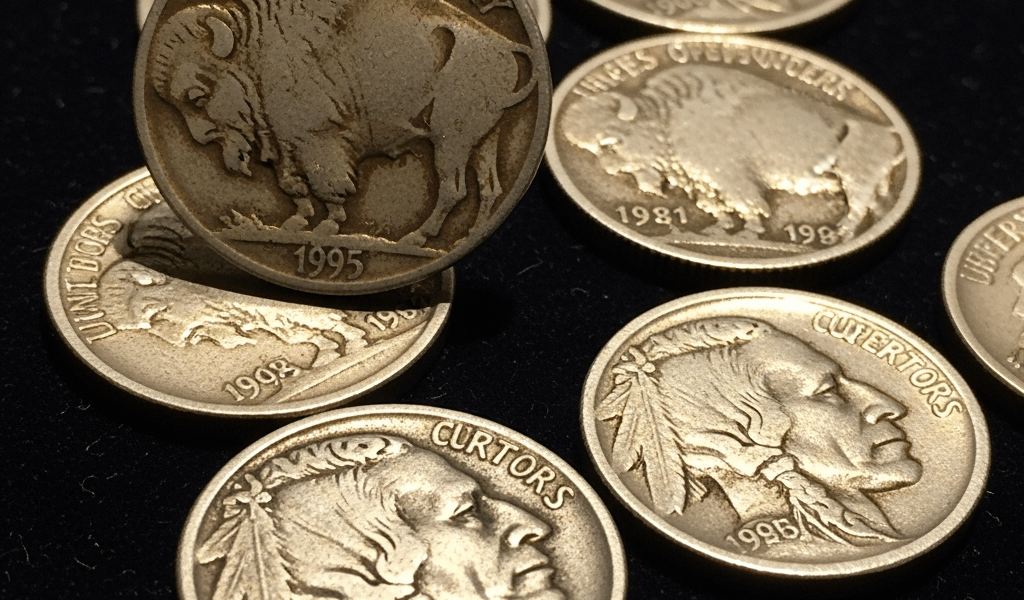
James Earle Fraser designed these in 1913. The U.S. Mint ran production through 1938 — just 25 years total. That brevity matters more than most people realize. Philadelphia, Denver, and San Francisco all operated under different economic pressures, different demand cycles, wildly different output numbers. Some dates saw tens of millions struck. Others, barely a fraction of that. And Fraser’s raised-relief design — that bold Indian profile, that massive buffalo — wore faster than almost any other circulation coin in American history. Finding one with a fully legible date is already a small win.
But what is a Buffalo nickel, really? In essence, it’s a five-cent coin struck between 1913 and 1938. But it’s much more than that. It’s one of the few American series where a circulated Good-4 example of the right date can command serious money — no slabbed holder required. A Very Fine-20 from an overlooked mint year? That’s where collector passion actually lives. That’s what makes this series endearing to us hobbyists. So, without further ado, let’s dive in.
The True Key Dates You Should Never Spend
Probably should have opened with this section, honestly. Three dates stand completely apart as legitimate keys — coins collectors have hunted for generations. They are the 1913-S Type 2, the 1921-S, and the 1926-S. When people ask me which Buffalo nickels are actually worth keeping, these three come up first every single time.
1913-S Type 2
Frustrated by early complaints that the original design looked too crowded, the Mint redesigned the reverse buffalo and repositioned the Indian head mid-year in 1913 — using a modified hub that created what collectors now call the Type 2 reverse. San Francisco struck only 1.2 million of them. Fewer than half the Philadelphia total. A heavily worn Good-4 example trades around $12 to $18 right now. Push into Very Fine-20 territory and you’re looking at $45 to $80. Even a dateless 1913-S — where only the mintmark proves identity — commands $6 to $10. The S itself is that scarce.
1921-S Buffalo Nickel
San Francisco made 1.5 million of these in a year when nickel coinage demand had largely collapsed across the country. Good-4 examples sit around $8 to $14. Very Fine-20 runs $35 to $55. Fewer examples survived heavy circulation — that’s the real story here, not just the mintage number. I’m apparently lucky with estate finds, and a 1921-S in anything above Good condition works for me as an instant highlight while common-date nickels never excite me the same way. Don’t make my mistake of overlooking these in mixed dealer lots.
1926-S Buffalo Nickel
San Francisco struck just 970,000 pieces in 1926. This is the date that separates casual collectors from serious hunters. Good-4 grades typically trade for $10 to $16. A clean Very Fine-20 can fetch $50 to $75. The low mintage combined with brutal wear patterns makes finding one in above-average condition genuinely difficult — not impossible, but the kind of find that justifies the whole afternoon of sorting.
Semi-Key Dates That Slip Through Unnoticed
The semi-keys — 1919-D, 1919-S, 1924-S, and 1925-D — regularly trade below their actual scarcity because collectors fixate on headline keys. I’ve bought these from dealers practically at face value more than once. They weren’t the “famous” dates. Nobody was watching.
1919-D Buffalo Nickel
Denver minted 8.0 million that year. Sounds abundant. It isn’t — most are worn completely smooth. Finding a Good-4 is easy enough. Finding a Very Fine is not. Good-4 trades around $3 to $5. Very Fine-20 reaches $18 to $30. The D-mintmark also carries regional pull with collectors across Colorado and the broader Mountain West — that drives premiums beyond what raw mintage math alone would suggest.
1919-S Buffalo Nickel
San Francisco produced 1.9 million that same year. Same basic logic applies. Good-4 runs $4 to $7. Very Fine-20 reaches $20 to $35. The S-mark carries prestige beyond mintage numbers — West Coast regional demand pushes these consistently above what you’d expect.
1924-S Buffalo Nickel
Just 1.4 million struck. Grade matters enormously here — more than almost any other semi-key in the series. A worn Good-4 sits at $5 to $8. A premium Very Fine-20 example with strong strike definition and genuine light wear can reach $30 to $50. This is where collector knowledge actually separates good finds from overlooked fodder.
1925-D Buffalo Nickel
Denver produced 4.4 million — again, sounds high until you’re hunting rolls at a flea market and find exactly zero. The D-mark alone makes it worth sorting. Good-4 grades trade around $3 to $5. Very Fine-20 climbs to $15 to $28. Not headline-grabbing. Quietly undervalued compared to the more famous keys, though. Pick them up when you can.
The 1937-D 3-Legged Buffalo — Variety or Key Date
This one deserves its own conversation. In 1937, a Denver Mint worker over-polished a reverse die — removing the buffalo’s front right leg in the process. That polished die kept running. The result was a small production run of nickels showing a three-legged buffalo, sharp in every other detail but clearly missing that limb.
Distinguishing a genuine 3-legged piece from a damaged normal coin requires hands-on inspection — at least if you want to avoid an expensive mistake. The genuine variety shows a clean, sharply defined leg area with no tool marks, no pitting, no evidence of filing. Counterfeit examples exist. They usually show rough surface texture, uneven wear inconsistent with normal circulation, or amateur grinding marks near the missing leg.
A genuine 3-legged Buffalo in Good-4 condition trades around $25 to $40. Very Fine-20 examples command $75 to $150. The variety attracts both error collectors and type set builders — broad demand from two different collector pools. That said, authentication matters here more than almost anywhere else in the series. Don’t assume a missing leg equals automatic value. Examine it closely under a 10x loupe or run it by a reputable dealer first.
How to Read a Dateless Buffalo Nickel Before Writing It Off
Dateless Buffalo nickels have gotten a bad reputation with all the “worthless junk” thinking flying around. That’s not entirely fair.
The raised date numerals on the obverse were the first detail to vanish under pocket wear — Fraser’s high-relief design made that inevitable. But here’s what most people miss: the mintmark often survives when the date doesn’t. Look on the reverse, below the buffalo, directly above the ground line. An S means San Francisco. A D means Denver. Philadelphia struck with no mintmark at all. Finding a dateless Buffalo with a clear S or D instantly narrows the field — a dateless S-mark coin from a semi-key year jumps from seemingly worthless to $2 to $8 depending on remaining surface details.
While you won’t need a full grading library, you will need a handful of basic tools. A solid 10x loupe — the Bausch & Lomb Coddington at around $18 runs well — and a decent reference like the Red Book are genuinely enough to start making smart calls. First, you should check for full horn definition and sharp buffalo details — at least if you want to appeal to type set collectors who actively build Buffalo nickel sets without chasing specific dates. These dateless pieces typically trade for $0.75 to $3. That beats writing them off entirely.
Acid-dipping or chemically restoring a dateless Buffalo to recover the date might be the worst option here, as the series requires original surfaces to hold any legitimate collector value. That is because grading services will not certify treated coins — and the market recognizes cleaned surfaces instantly. A naturally worn dateless nickel commands more respect and more money than an artificially recovered one every single time. Don’t make my mistake of thinking otherwise early on.
Buffalo nickels reward collectors who understand context, not just the headline rarities. Start sorting pocket change. Pull estate accumulations carefully. The key dates and semi-keys are still out there — waiting for someone paying attention.

Stay in the loop
Get the latest global coin collector updates delivered to your inbox.