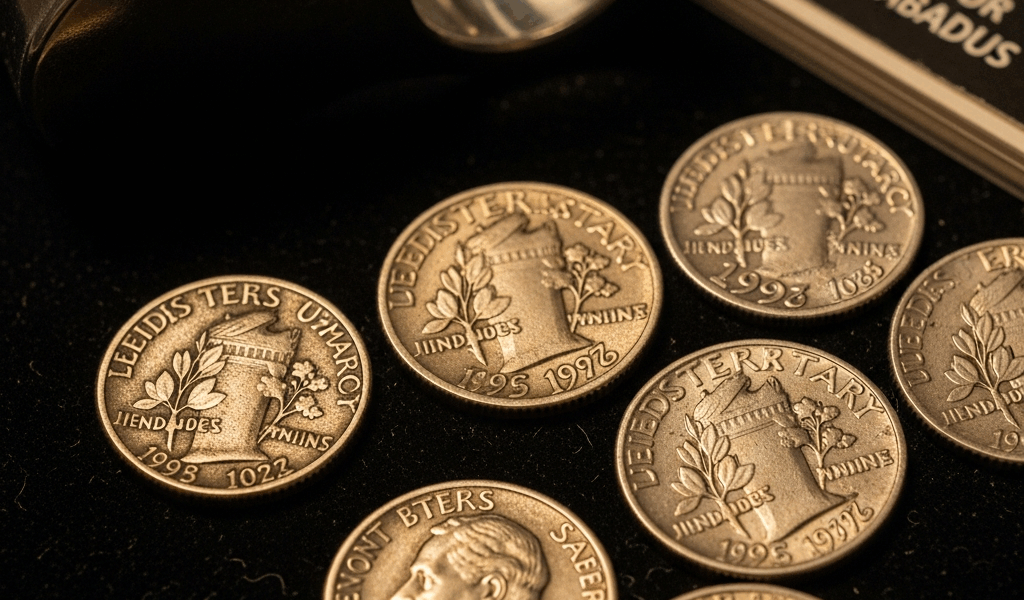
Why Seated Liberty Dimes Reward Variety Hunters
Seated Liberty dime collecting has gotten complicated with all the misinformation flying around. As someone who has spent eight years hunting varieties across shows, auction archives, and dealer tables, I learned everything there is to know about this series the hard way. Today, I will share it all with you.
The Seated Liberty dime ran from 1837 to 1891. Fifty-four years. Multiple mints, design overhauls, and die varieties that keep collectors like me coming back year after year. But what is a die variety, exactly? In essence, it’s a coin struck from dies with measurable differences — repositioned digits, doubled elements, distinct punch characteristics. But it’s much more than that. It’s a paper trail left by mint workers operating under real production pressure, using tools that weren’t perfect and never pretended to be.
Unlike Morgan dollars or Indian cents, Seated Liberty dimes sit in this sweet spot where even heavily circulated examples can be attributed to specific die marriages. The Fortin reference — the Essential Guide to the Seated Liberty Dime — documents hundreds of these marriages with actual photography and die characteristics you can verify in hand. That’s what makes this series endearing to us variety hunters. So, without further ado, let’s dive in.
Early Dates and No-Stars Subtype Worth Knowing
The 1837 and 1838 no-stars pieces are where variety hunting gets immediately actionable. Probably should have opened with this section, honestly.
On the 1837, you’ll encounter either a Large Date or Small Date obverse. This isn’t subtle. The numerals on a Large Date 1837 are visibly taller and wider — sometimes dramatically so — than the Small Date version. I’ve handled maybe a dozen 1837 dimes across shows and auction floor viewings, and the Large Date seems more common in my experience. The Small Date commands marginally more collector attention despite that. Both exist in circulated grades. Both are obtainable without spending beyond mid-tier budgets. Both can be correctly identified even in Fine condition.
The 1838 introduces two critical developments. Philadelphia produced the regular issue. Then New Orleans struck its first Seated dimes — the 1838-O. Finding a circulated 1838-O isn’t difficult. But it was the variety that actually made me understand why these date-specific hunts matter. Every 1838-O represents a specific moment in U.S. mint history, and holding one makes that tangible in a way reading about it never quite does.
The no-stars subtype closed out entirely after 1838. VF examples are legitimately scarce. Fine is your realistic target going in.
Stars Obverse Dates With Notable Die Varieties
From 1838 forward through 1860, the obverse added thirteen stars flanking Liberty — one per original state. This long subtype holds more variety interest than newcomers realize. Don’t make my mistake of skimming past it early on.
Repunched dates pepper this period. The 1843 exists with a repunched 3, where the working die was used, adjusted, and stamped again with slightly offset positioning. In Fine or VF condition, this shows as a ghost image of the digit sitting behind the primary numeral. It isn’t rare. You won’t pay premium money chasing one. But it’s real, attributable, and genuinely satisfying to spot once you’ve trained your eye.
Skip ahead to 1853. Frustrated by the ongoing drainage of silver from domestic commerce, U.S. Treasury officials authorized a reduction in silver content for dimes and quarters, marking the change by adding arrows flanking the date and rays emanating from the reverse eagle. That was 1853. The with-arrows-and-rays version represents that precise policy moment. A VF or XF 1853 with arrows and rays is a conversation piece — proof you understand what the series was actually doing across its fifty-four years.
The 1856 occasionally appears in Small Date and Large Date variants, though attribution confidence varies by mint. The Fortin reference assigns these, but I’ve learned through trial that not every worn example yields a confident call without a direct side-by-side comparison. I’m apparently detail-obsessed about this, and having a reference coin works for me while eyeballing catalog images alone never quite does.
Jump to 1860-O. New Orleans mint dimes from this year carry collector demand well beyond base type value. The 1860-O is the final Seated dime from New Orleans under the stars obverse — a last-of-type finish point that pulls in completionists building mint-by-mint collections. That’s what makes it endearing to us branch mint hunters.
Legend Obverse Transitional Years Collectors Target
The 1860 legend reverse represents the biggest design shift in the entire series after the original no-stars period. The new reverse added “UNITED STATES OF AMERICA” around the rim, replacing the previous text arrangement. Philadelphia and New Orleans both produced 1860 dimes. Both are obtainable. Both benefit from being design-change markers — exactly the type of date that drives variety hunting psychology.
But what is design-change psychology? In essence, it’s the collector impulse to own a documented moment rather than just a coin. But it’s much more than that. It’s how a series becomes a narrative rather than a list.
Then comes 1873. Arrows returned to flank the date — another silver weight adjustment — and here’s where die varieties really shine. The 3 in 1873 exists in both close and open configurations on certain dies. The spacing between the numerals shifts noticeably. In circulated grades, this is genuinely visible and attributable without magnification. An 1873 with an open 3 is the variety hunter’s play here. PCGS recognizes these in their certification holders when properly submitted.
The 1873 and 1874 arrows period lasted only two years. Any attributed arrow dime from this window is part of a short-lived type. Most dedicated collectors grab both the arrow and non-arrow 1873 examples. I own both. Paid around $140 combined for circulated examples several years back — nothing dramatic, but both earn their spot in the box.
Late Series Dates and Condition Rarity Worth Pursuing
Carson City mint dimes from the 1870s and 1880s are where my perspective shifted after examining actual coins against catalog prices. The 1874-CC and 1871-CC exist in quantities low enough that finding anything meaningfully above Fine grade becomes statistically difficult. These coins were struck in small volumes at a frontier mint operating with limited resources. Circulation was heavy. Survival above VF is genuinely rare — not artificially so, just mathematically.
An 1874-CC in Fine condition is obtainable for mid-tier collector budgets. It will never be common. That scarcity in circulated states makes it infinitely more interesting than a Philadelphia dime of identical date. That’s what makes Carson City pieces endearing to us condition-rarity hunters — the mintmark isn’t decorative. It’s documentary.
The 1891 represents the series’ final year. Does the last Philadelphia strike offer significant variety attribution opportunities? Honestly, not much. The design had been static for years. But closure-collectors pursuing complete year-by-year sets make 1891 their finish line, and that’s legitimate. There’s real satisfaction in owning the last struck.
While you won’t need a research library and unlimited capital, you will need a handful of specific resources. First, you should acquire the Fortin reference before committing real money to any coins — at least if you want to avoid overpaying for common dates I’ve seen priced as scarce ones at major shows. The Fortin reference might be the best option, as Seated Liberty variety work requires accurate die documentation. That is because misattributed coins lose value fast the moment a more informed buyer examines them. Request PCGS variety attribution when submitting. Target VF and Fine grades initially. Build around type coins first — no-stars, stars obverse, legend reverse, arrows issues — then hunt specific dates within each type. This new approach takes hold within a few months and eventually evolves into the methodical practice serious Seated Liberty enthusiasts know and trust today.
The rabbit hole is real. The knowledge you build is real. The coins others overlook — that’s where the actual satisfaction lives.


Stay in the loop
Get the latest global coin collector updates delivered to your inbox.