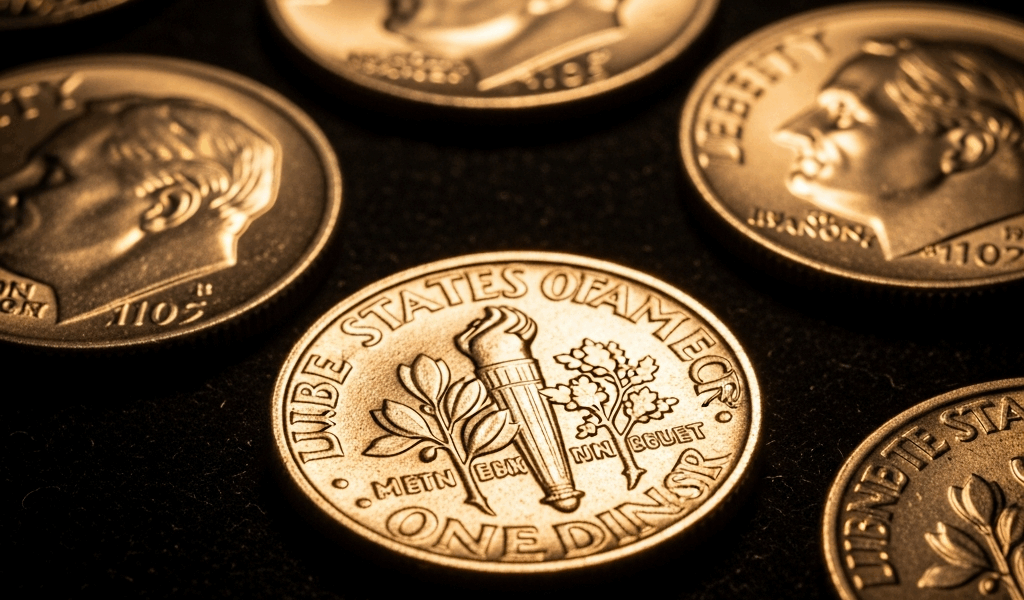
Why Roosevelt Dimes Still Reward Careful Eyes
Roosevelt dime collecting has gotten complicated with all the misinformation flying around. As someone who’s spent years digging through bank rolls, tip jars, and laundromat change machines, I learned everything there is to know about hunting these coins for errors. Today, I will share it all with you.
But what is a Roosevelt dime error coin? In essence, it’s a dime that left the U.S. Mint with an unintended flaw — a doubled die, a missing mintmark, a misaligned strike. But it’s much more than that. It’s a window into how dies wear, shift, and sometimes fail entirely under the pressure of mass production. The series has run since 1946. That’s a long production window, and errors crept in throughout.
The coins came in 90% silver from 1946 through 1964, then switched to clad copper-nickel from 1965 onward. Errors show up across both eras with roughly equal frequency. That’s what makes this series endearing to us collectors. You don’t need to chase expensive early American coins sealed in plastic slabs. These things still turn up in your change. So, without further ado, let’s dive in.
Doubled Die Roosevelt Dimes Worth Confirming
The 1955-D Roosevelt dime is the one to know first. Struck at the Denver Mint, it carries a dramatic doubled die obverse — most visible on “IN GOD WE TRUST” and the date numerals. Letters look slightly offset, almost shadowed, like the die hit from two marginally different positions. Frustrated by squinting at coins under bad lighting, I eventually started angling a 10x loupe directly at the motto line instead of looking straight down. Made an immediate difference.
Here’s what most articles skip entirely: machine doubling versus hub doubling. They are not the same thing. Machine doubling happens when a struck coin shifts slightly before a second strike lands — worthless, common, not a real error variety. Hub doubling happens earlier, during die production itself. The hub is doubled before it ever touches a blank. Every single coin struck from that die carries the error permanently. You can tell them apart. Machine doubling shows up only on the highest design points. Hub doubling affects the entire design evenly across every coin from that specific die.
Later doubled die varieties exist too. The 1982-D shows minor doubling on the date numerals — less dramatic but documented. CONECA (the Combined Organization of Numismatic Error Collectors of America) catalogs these designations. Cross-reference Wexler’s Die Varieties Online before finalizing any identification. A confirmed DDO in circulated condition typically trades somewhere between $15 and $40, depending on how bold the doubling reads and what grade the coin carries.
The 1982 No-P Dime and What Makes It Genuine
Probably should have opened with this section, honestly. Philadelphia Mint dimes carried no mintmark at all before 1980 — no letter, clean field, simple. The “P” got added in 1980 specifically to distinguish Philadelphia coins from other mint output. Then in 1982, a small batch slipped through without the P. A die was prepared without the mintmark punch. Those coins are real errors, and they’re genuinely scarce.
The problem is that collector demand created a counterfeiting incentive almost immediately. Some sellers grind or fill the P mintmark off normal 1982 Philadelphia dimes and sell the results as genuine errors. Don’t make my mistake — I nearly paid $200 for a ground example before someone more experienced pointed out the tool marks under a loupe.
A genuine 1982 No-P shows a completely smooth field between the date and the rim, right where the P should sit. The metal surface is uniform. Nothing was ever there. A tampered coin tells a different story — microscopic scratches, slight surface unevenness, or faint ghost traces of the original letter that didn’t fully disappear. Use 10x magnification minimum. Hold the dime under a strong LED light at a low, roughly 15-degree angle and rotate it slowly. Normal wear distributes across the entire coin face. Suspicious wear concentrated only in that one small area near the date is a red flag.
Genuine examples graded MS-64 and above command $300 to $600. Circulated specimens sell for $75 to $150. Estimates suggest somewhere between 500 and 1,000 genuine examples exist — not artificially scarce, just genuinely uncommon.
Off-Center Strikes, Die Caps, and Broadstrikes to Know
Off-center strikes happen when a coin blank misses its proper seat in the striking collar. The die connects at an angle or partial position. Minor misalignment — say, 2 to 4 percent of the design missing — usually goes unnoticed and uncollected. The threshold shifts dramatically at 10 to 15 percent. That’s where the coin becomes something worth pulling from circulation and examining properly. A Roosevelt dime with 20 percent or greater off-center misalignment in XF condition trades for $30 to $80 depending on how cleanly the date still shows.
Broadstrikes are a different mechanical failure. The restraining collar — the ring that normally holds the coin’s diameter during striking — fails to engage or retracts early. The metal spreads outward. A broadstruck Roosevelt dime measures roughly 19 to 20mm across instead of the standard 17.9mm. Design elements push out onto what should be blank rim space. I’m apparently detail-oriented about measurements and keeping a small digital caliper works for me while eyeballing proportions never does. Worth the $8 the caliper cost.
Die caps are the dramatic one. A struck coin sticks to the die face instead of ejecting normally. As striking continues, subsequent blanks hit that stuck coin, gradually wrapping it around the die like a cap. Coins produced afterward come out distorted — raised impressions of the stuck coin visible across the design. Die cap errors are rare on Roosevelt dimes but documented across both the silver and clad eras. They fetch $100 to $300 depending on how severe the distortion reads and what grade the piece carries.
Condition matters across all three error types. A broadstrike in MS-63 commands genuine respect from buyers. The same error heavily worn loses visual impact — and premium along with it.
How to Examine Roosevelt Dimes Without Missing Errors
While you won’t need a professional numismatic setup, you will need a handful of specific tools. A 10x jeweler’s loupe — around $9 to $14 from any decent online retailer. An angled LED light source. I use a basic $12 rechargeable desk lamp rotated to roughly 45 degrees. And a reference like Wexler’s Die Varieties Online, which is free. That’s the entire kit.
First, you should examine the date and mintmark area — at least if you’re hunting doubled dies and no-P varieties, which cluster right there. Rotate the dime slowly under the loupe. Different angles reveal different things. Straight-down examination misses a lot of what angled light catches.
Move to the motto next. “IN GOD WE TRUST” on the obverse is a doubled die hotspot on the 1955-D. Look for letter shadowing or slight offsets. Then check the rim itself — an off-center strike or broadstrike distorts rim thickness or pushes design elements into rim space that should be completely blank.
A heavily worn 1955-D doubled die might show only subtle evidence of the variety compared to a lightly circulated example. Worn condition doesn’t disqualify a coin, but it genuinely complicates identification. When uncertain, photograph the dime in strong light and compare your image directly to cataloged examples on CONECA or Wexler’s. The reference images are there specifically for this.
Fresh bank rolls still produce finds. That was true in 1996 and it’s still true now. Most people running change through their hands never look closely. You do. That’s the only edge this hunt actually requires.


Stay in the loop
Get the latest global coin collector updates delivered to your inbox.