How to Get Coins Graded Without Paying $30 Per Coin
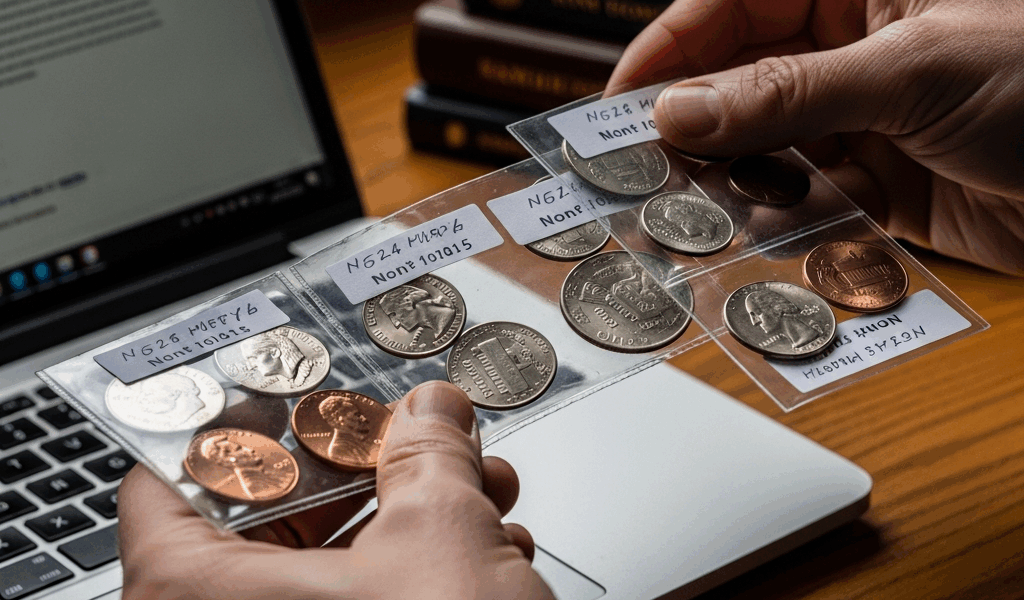
Coin grading has gotten complicated with all the misinformation flying around — especially for newcomers who assume professional certification is the only path worth taking. I made that assumption myself. Dropped six Morgan dollars into a PCGS submission early on, paid full standard fees, and got back slabs I could have predicted with thirty minutes of research and a halfway decent loupe. That stung. What follows is every realistic option laid out honestly — free tools, economy tiers, club memberships, and the cases where professional grading genuinely earns its fee.
This article includes affiliate links. We may earn a commission at no extra cost to you.
Free Options — What You Get and What You Don’t
Free grading resources are real. They’re just not certifications. There’s an important difference, and understanding it saves a lot of frustration.
PCGS Photograde Online
But what is PCGS Photograde? In essence, it’s a free photo-based grading reference at pcgs.com/photograde. But it’s much more than that — the tool shows high-resolution images of coins at each grade point on the Sheldon scale, from AG-3 up through MS-70, across dozens of series. You find your coin type, compare wear patterns side by side, and arrive at a reasonable estimate. Surprisingly accurate for circulated coins once you get the hang of it. The photos are well-lit and representative.
The limitation is that you’re working without tactile feedback — the tool doesn’t account for luster, strike sharpness on specific die pairings, or surface preservation beyond visible wear. Close enough for buying decisions. Not close enough for selling a key date.
NGC’s Coin Grading App
NGC offers a free app on iOS and Android that walks you through a grading checklist and lets you compare your coin’s photos against reference images. It’s more interactive than Photograde — asks specific questions about contact marks, luster, and strike. The grade it outputs is an approximation, and NGC is upfront about that. The app is educational, not a substitute for their certification service. Still, I’ve used it on coins I was considering buying at shows. Calibrated my expectations well before I started negotiating a price, honestly.
Heritage Auctions Free Appraisals
Heritage Auctions offers free appraisal submissions through their website. You photograph your coin, submit it through their consignment portal, and a specialist responds with an estimated grade and auction value. Genuinely useful — especially for potentially valuable coins you haven’t had assessed before.
The catch, and it’s worth knowing upfront, is that Heritage’s business model is auction consignment. The appraisal is free because they’re hoping you’ll consign the coin with them. That’s fine. You’re under no obligation, and the information you receive is usually reliable.
Taken together, these three free tools can get you 80% of the way there on most common coins. For modern clad, copper cents, or heavily circulated silver, that’s often enough.
Economy Grading Tiers at PCGS and NGC
Both major third-party grading services offer tiered submission options, and the economy tiers are substantially cheaper than most people realize.
PCGS currently offers an Economy tier priced around $22 per coin — verify current pricing at pcgs.com, since fees adjust periodically. The tradeoff is turnaround time. Economy submissions can take 60 to 120 business days. That’s four months on the slow end. If you’re building a collection for personal enjoyment and not trying to flip coins on a deadline, that wait is manageable. NGC’s equivalent is their Economy tier at similar pricing. Check ngccoin.com for current rates.
When Economy Tiers Make Sense
Economy tiers work best when you have a batch of coins to submit at once. Sending in one coin at a time at any tier makes the per-coin overhead feel heavier — shipping, handling fees, return shipping all add up fast. Batch submissions of five to ten coins spread those fixed costs out. If you’re targeting a series and systematically upgrading your collection, accumulate a small group before submitting rather than sending coins individually every few weeks.
What Economy Tiers Don’t Cover
Both PCGS and NGC restrict economy tiers by maximum declared value. Coins with a presumed value above a certain threshold — typically $300 to $500 per coin depending on current tier rules — must be submitted at higher service levels. The reasoning is that high-value coins receive additional scrutiny during grading. Read the tier restrictions before you submit. Submitting a high-value coin under an ineligible tier just delays the process while they reclassify it and charge you the difference anyway.
Club Submissions — The Hidden Discount
Probably should have opened with this section, honestly. Club-based submissions are the most underused cost-reduction method in the hobby, and most beginners don’t even know they exist.
The American Numismatic Association — the ANA — offers members discounted submission rates with both PCGS and NGC. A standard ANA membership runs around $36 per year for adults, with reduced rates for juniors and seniors. The submission discounts alone often justify that annual fee within a single batch of coins. Beyond discounts, ANA membership gets you access to their lending library, educational resources, and a network of local clubs that’s larger than most people expect.
How to Find a Local Club
The ANA’s club directory at money.org lists affiliated coin clubs by state and city. Local clubs frequently organize group submissions — pooling multiple members’ coins into a single submission batch. Group submissions often qualify for bulk pricing that individual collectors can’t access on their own. The club coordinator handles the paperwork and the shipping. You hand over your coins, pay your share, and wait.
Stumbled into this arrangement at a club meeting in my area. A retired postal worker named Gerald was coordinating a group NGC submission for about fourteen members — twelve coins total. The per-coin cost after splitting shipping and applying the group rate came out to just under $18 per coin. That’s a meaningful difference from standard pricing. Don’t make my mistake of skipping local clubs for the first two years of the hobby.
Online Communities as a Substitute
If there’s no local club nearby, communities on the Coin Community Forum and the r/coins subreddit sometimes organize informal group submissions. These require more trust in people you’ve never met, so vet participants carefully — but the option exists. Several established members in those communities run group submissions regularly and have solid reputations for honest dealing.
Self-Grading — How to Get Pretty Close on Your Own
Self-grading isn’t a substitute for certification when money is on the line. It is a genuinely useful skill for buying decisions, personal cataloging, and — maybe most practically — filtering which coins are even worth the cost of professional grading in the first place.
The Sheldon Scale Basics
The Sheldon scale runs from 1 to 70. Circulated coins fall between 1 and 58, with grades like Good (G-4), Very Fine (VF-20 through VF-35), and Extremely Fine (EF-40, EF-45). Mint state coins run from MS-60 through MS-70. The practical difference between MS-64 and MS-65 on a Morgan dollar can be hundreds of dollars — that’s where self-grading becomes unreliable without significant experience. For circulated material, though, you can get within a grade or two consistently with practice.
The Right Equipment
While you won’t need a professional grading room setup, you will need a handful of basic tools. A 10x loupe is the standard for coin examination — I use a Bausch + Lomb 10x Hastings triplet that cost around $28 on Amazon. You also need a consistent light source. A single-point LED flashlight held at a low angle to the coin’s surface reveals contact marks and luster better than overhead lighting will. A desk lamp with an adjustable arm works well too.
Examine coins over a soft surface — a velvet pad or a folded microfiber cloth — so that if you drop them, you’re not adding fresh damage while you’re trying to grade for existing damage. Sounds obvious. Apparently not everyone figures this out before it’s too late.
What to Look For
- High points first. On a Morgan dollar, check Liberty’s cheek, the eagle’s breast feathers, and the hair above the ear. These are the first areas to show wear.
- Luster quality. Mint state coins have cartwheel luster — a rolling sheen that moves across the surface as you tilt the coin under light. Once luster is broken by friction, the coin is circulated regardless of how sharp the details look.
- Contact marks. Bag marks, hits, and scrapes from contact with other coins. These affect grade significantly in mint state coins and less so in circulated grades.
- Strike sharpness. Some coins are weakly struck at the mint — this is different from wear and can cause undergrading if you’re not familiar with typical strike quality for a given date and mint.
The best learning resource for self-grading might be the best option overall, as building this skill requires a solid reference baseline. That is because the gap between guessing and grading comes down to knowing what “normal” looks like for each series. Ken Bressett’s Official American Numismatic Association Grading Standards for United States Coins — commonly called the ANA Grading Guide — is available used on eBay for around $8 to $12. Same reference professional graders use as a baseline.
When Professional Grading Is Actually Worth the Money
There’s a fairly straightforward threshold here: if the coin’s retail value in the grade you believe it to be is at least five times the grading fee, professional certification makes financial sense. Below that ratio, the fee takes too large a bite relative to the value it adds or confirms.
Key Dates
Key dates justify grading fees at almost any realistic grade. A 1916-D Mercury Dime in VF-20 retails for over $800 in a slab — the grading fee is trivial by comparison. Raw key dates also attract skepticism from buyers. Certification removes authentication concerns and broadens your potential market significantly. That’s what makes third-party grading endearing to us collectors when the coin actually warrants it.
High-Grade Common Coins
A common-date Morgan dollar in MS-64 retails around $75 to $100 raw. In an NGC or PCGS MS-64 slab, the same coin brings $120 to $150 or more, depending on eye appeal. The premium covers the grading fee with room left over. At MS-65, the premium widens further. The calculation shifts entirely at lower grades — a circulated common Morgan in VF-30 isn’t worth slabbing for the market premium it generates.
Error Coins
Error coins — doubled dies, off-center strikes, repunched mintmarks — benefit enormously from professional authentication. Errors are easy to fake, and raw error coins are regarded with suspicion by experienced buyers. A certified error carries a liquidity premium that a raw example simply doesn’t. Find what looks like a significant doubled die on a Lincoln cent? The economics of certification are almost always favorable. Get it graded.
Coins You Intend to Sell
Personal collection coins you’ll hold indefinitely may not need slabbing at all. First, you should self-grade them and log them accurately — at least if you’re building a collection primarily for personal enjoyment. The moment you’re considering selling to a dealer, at auction, or to an individual buyer who doesn’t know you personally, certification shifts the risk of grade disputes away from you and onto an independent third party. That has real value in any significant transaction.
Grading doesn’t have to be a $30-per-coin proposition. Between free photo grading tools, economy submission tiers, ANA membership discounts, and club group submissions, the realistic floor is well below what most beginners assume. Start with the free tools, develop your self-grading eye, join your local club, and reserve professional certification for coins where it genuinely changes the math.

Stay in the loop
Get the latest global coin collector updates delivered to your inbox.