Walking Liberty Halves Have Gotten Complicated With All the Noise Flying Around
As someone who has logged more hours in coin shops than I care to admit, I learned everything there is to know about Walking Liberty half dollar varieties the slow way — through bad purchases, missed details, and a lot of time squinting at dealer bins. Today, I will share it all with you.
This article includes affiliate links. We may earn a commission at no extra cost to you.
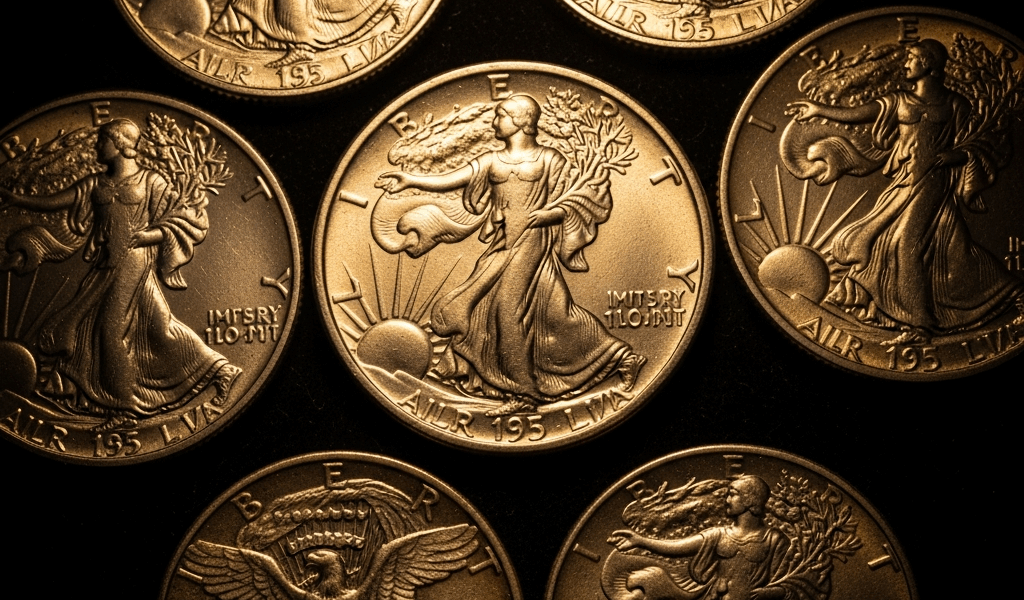
Adolph Weinman’s Liberty design ran from 1916 to 1947. That’s 31 years. On the obverse, Lady Liberty is literally mid-stride — robe trailing behind her, clutching laurel and oak branches like she’s late for something important. Flip it over and you get an eagle perched on a rock, wings folded. Not aggressive. Composed. There’s a restraint to that image that modern coinage simply doesn’t bother with anymore. I’ve handled probably three hundred of these coins at this point, and the design still stops me cold.
But what is a serious Walking Liberty collector? In essence, it’s someone hunting stories rather than silver weight. But it’s much more than that. A real collector understands that building a complete date-and-mintmark set means assembling a physical record of American economic decisions — every coin tied to a specific mint, a specific year, a specific reason for existing. Philadelphia. Denver. San Francisco. Each facility responded differently to bullion demands, production pressures, wartime needs. The why behind each coin is what makes the hunt meaningful.
Own one 1921 Walking Liberty and you’ve got a beautiful coin. Own the full 1921 date run — both P and D — and you’ve got a story about Treasury contraction, depressed mintages, and why production looked nothing like it would by 1945. That’s what makes this series endearing to us collectors. So, without further ado, let’s dive in.
The 1916 Issues — Three Coins With One Debut Year
Walking Liberty halves launched at three mint facilities simultaneously in 1916. That alone creates a variety situation that still catches new collectors off guard every single time.
The Philadelphia 1916 — no mintmark — came first. Straightforward entry into a 31-year run, no drama. Then came the 1916-D and 1916-S. Here’s where things get interesting: both the Denver and San Francisco coins carry their mintmarks on the obverse, sitting below the date. That placement changed later. By 1917, mintmarks moved to the reverse, tucked below the eagle’s left wing. Two different locations. One year apart. Easy to miss if nobody tells you.
Probably should have opened with this section, honestly. I purchased what I thought was a standard 1916 half without checking the mintmark position, then spent an entire Saturday afternoon staring at it next to my other Denver pieces wondering why something felt off. I’m apparently detail-blind on my first pass and catching errors on the second look works for me while spotting them instantly never does. Don’t make my mistake. If you’re hunting 1916 issues, confirm the mintmark location before the transaction closes. The obverse position is the rarer placement. Missing it costs money in both directions — you’ll either overpay for a common reverse-mark specimen or walk past an actual obverse variety sitting right in the bin.
Eye appeal matters more on these coins than the certification number suggests. These pieces are over a century old. A little wear isn’t damage — it’s a hundred years of evidence. Look instead for original color on the reverse, strike quality showing full feather detail on the eagle’s wing, and surfaces that haven’t been scrubbed clean. A 1916-S grading an honest VF-30 with original patina will teach you more about this series than a slabbed AU that’s been through a tumbler and back.
Why Mintmark Position Matters Beyond Price
The 1917 shift from obverse to reverse mintmarks wasn’t arbitrary — it reflected a specific procedural decision made at the mint level. Once you know this, you’ll never confuse a 1916-era coin with anything that came later. You’ll catch attribution errors faster. You’ll understand the human fingerprints left all over the coining process. That context is what separates a collector who knows the series from one who just owns examples of it.
Key Dates From the 1920s That Define a Complete Set
If 1916 is the design debut, 1921 is the rarity gateway. Both the 1921-P and 1921-D are genuine key dates. Not semi-keys. Keys.
Production collapsed that year. The U.S. Treasury was sitting on enormous silver reserves with almost no demand for new coinage. Philadelphia struck just 246,000 pieces. Denver struck 208,000. Compare that against the 1940s, when annual production regularly cleared 10 million coins per year. The gap is staggering — and it’s exactly why 1921-dated Walking Liberties have commanded serious premiums for decades running.
Here’s the collector-level reality nobody talks about enough: 1921 Walking Liberties frequently show strike quality problems. Worn dies. Inconsistent pressure. You’ll find examples where Liberty’s head isn’t fully struck, where feather detail blurs together across the eagle’s wing, where lettering reads soft. That’s not damage. That’s the signature of 1921 production. When hunting this date, prioritize surface originality over technical grade. An honest VF-25 with original skin and zero cleaning beats an AU-50 that’s been dipped. The original coin ages better in a collection. It also tells the truth about what 1921 actually looked like coming off the press.
The 1921-D is scarcer still. Denver’s 208,000 pieces represent the lowest mintage of the three facilities that year — and Denver was the only one of the three to strike halves, making the comparison even starker. Budget more time and more money for the D-mint variant. But once you own both coins, you’ve got the two most historically significant pieces in the entire series sitting in the same album. That satisfaction is immediate and completely tangible.
Overlooked Semi-Keys Worth Hunting in Dealer Bins
Not every valuable variety needs key-date money attached to it. Some of the most rewarding finds sit in dealer bins because collectors have ignored them — not because they’re actually common.
The 1938-D is the clearest example. Denver production dropped again that year, yielding just 491,120 pieces. Not 1921-level scarcity, but noticeably rarer than the Philadelphia equivalent. I’ve pulled solid VF to EF examples from active shopping sessions for reasonable four-figure prices — sometimes barely into four figures. The 1938-D doesn’t feel like a dramatic hunt because most collectors are looking elsewhere. That oversight is collector advantage, plain and simple.
The 1919-D and 1923-S round out an underappreciated trio. Both saw limited production. Both show up in genuinely collectible grades without requiring museum-quality preservation to be worth owning. A VF-35 1919-D with original light blue toning isn’t glamorous inside a plastic slab. In hand, it’s genuinely beautiful — and it fills a real date in your run without wrecking your budget for the quarter.
Talk to dealers who handle Walking Liberties regularly. They know which dates are actually scarce in mid-grades versus which pieces are simply expensive. A 1938-D in EF condition is genuinely hard to locate. A 1938-D in pristine MS-65 mostly doesn’t exist — which is why certified examples at that level carry extreme premiums, but also why chasing perfection defeats the whole point of building a set.
How to Start a Walking Liberty Set That Actually Gets Finished
Assembling this series requires a real strategy. Without one, you’ll chase rare dates at random, hit budget walls, and abandon the project somewhere around 1930.
First decision: complete date-and-mintmark set, or date-only? A full date-and-mintmark collection runs 66 coins — three mints, 1916 through 1947, accounting for missing facility combinations. A date-only set needs 32. The scope determines your realistic timeline and budget ceiling. Know this before you buy coin number one.
First, you should acquire key dates early — at least if you want your collection to actually get finished. The 1921-P, 1921-D, and 1938-D get harder to budget for as spending accumulates elsewhere. Lock them in while purchase power is fresh. Semi-keys and common dates follow naturally as time passes. You’ll never stress about finding a 1935-P. You might wait two years for a clean 1921 in the grade you actually want.
A Dansco album might be the best option, as Walking Liberty collecting requires visual accountability. That is because defined slots for each date-mintmark combination force you to confront what’s missing every single time you open the album. The Dansco Walking Liberty album runs around $25 to $35 — and it creates momentum in a way that coins rattling loose in a box simply cannot. Every empty slot is a reminder. Every filled slot is a small victory.
Handle coins minimally. Cotton gloves if you must touch them at all. Early 20th-century silver develops a natural patina — light toning on the reverse, pale color shifts on the obverse — that adds genuine value and communicates age honestly. Cleaning destroys that narrative permanently. A problem-free coin with original skin beats a cleaned AU every time, in every grade, at every price point.
Set a realistic timeline and hold to it. A date-only set might take two to three years of steady hunting. A full date-and-mintmark set might run five to seven. That’s not a flaw in the hobby. That’s the entire point. The hunt sustains collector interest longer than simple ownership ever could — and Walking Liberty halves are worth every year of it.

Stay in the loop
Get the latest global coin collector updates delivered to your inbox.