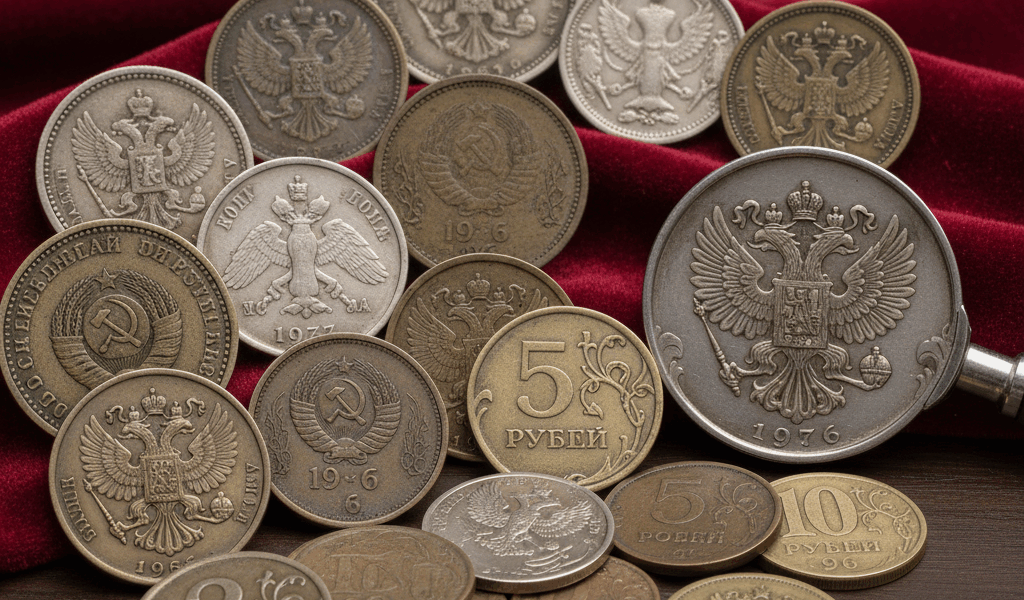
From the gold ducats of Imperial Russia to the humble kopeks of the Soviet era, Russian and Soviet coins offer collectors a remarkable journey through political upheaval, artistic evolution, and economic transformation. This collecting area spans over three centuries of numismatic history, encompassing some of the most dramatic political changes in world history.
Imperial Russian Coinage: The Tsarist Legacy
Imperial Russian coinage began its modern form under Peter the Great in the early 1700s, introducing Western-style minting techniques. The ruble became the standard monetary unit, with copper kopeks serving everyday commerce. Collectors prize the large copper 5-kopek pieces from Catherine the Great’s reign for their substantial size and detailed imperial eagles.
The gold coinage of Imperial Russia includes the 5-ruble, 10-ruble, and 15-ruble pieces, often featuring beautifully rendered portraits of tsars and tsarinas. Nicholas II gold coins remain among the most collected, minted until the 1917 revolution. Silver rubles from this era display exceptional craftsmanship, with commemorative issues for coronations and anniversaries commanding premium prices.
Revolutionary Period: Transitional Coinage
The 1917 revolution created numismatic chaos, with the provisional government continuing to use tsarist designs while the Bolsheviks consolidated power. Coins from 1917-1921 represent one of the most interesting transitional periods in world numismatics. The provisional government issued copper coins that still bore the imperial eagle, creating fascinating pieces that bridge two political eras.
During the civil war years, various regional authorities and governments-in-exile produced their own coinage, creating a complex field for specialized collectors. Many of these issues are quite scarce, as limited quantities were minted under wartime conditions.
Early Soviet Coinage: 1920s-1930s
The Soviet Union introduced new coinage in 1921, initially using silver for higher denominations before transitioning to cupro-nickel. The famous hammer and sickle motif appeared on these coins, along with the communist star and wheat ears representing workers and peasants. Early Soviet silver coins, particularly the 1924 poltinnik (50 kopeks), remain popular with collectors.
The 1920s saw the RSFSR (Russian Soviet Federative Socialist Republic) issues before the formal establishment of USSR coinage. These transitional pieces are highly sought after by specialists. The changeover to smaller, non-silver coins in the 1930s marked the end of circulating precious metal currency in the Soviet Union.
Stalin Era and World War II
Coinage during Stalin’s rule reflected the industrialization campaign and militarization of Soviet society. The 1935 coin redesign introduced new types that would remain largely unchanged until 1961. World War II brought significant changes, with aluminum-bronze replacing scarcer metals and some mintages severely reduced due to wartime priorities.
Wartime-dated coins, particularly from 1941-1945, can be challenging to find in higher grades, as many were lost or melted for the war effort. The Leningrad mint continued limited production even during the brutal siege, making these pieces particularly meaningful historically.
Post-War Soviet Coinage
The 1961 currency reform introduced the coinage familiar to most Soviet-era collectors. This series continued until the dissolution of the USSR in 1991, with commemorative issues becoming increasingly common from the 1970s onward. Olympic commemoratives from the 1980 Moscow Games are particularly popular, issued in both base metal and precious metal versions.
Late Soviet commemoratives celebrated revolutionary anniversaries, space achievements, and cultural figures. The quality and variety of these issues make them accessible to collectors at all budget levels. Proof and uncirculated sets from this era offer excellent value compared to similar Western issues.
Collecting Strategies and Key Dates
Building a Russian and Soviet collection can follow several approaches. Type collectors focus on one example from each major design or denomination. Date collectors pursue complete year sets for specific series. Commemorative specialists may focus on Olympics, space themes, or revolutionary anniversaries.
Key dates to watch include the 1947 silver rubles (never released for circulation), 1958 dated coins (pattern pieces only), and any pre-1917 gold. Early RSFSR issues from 1921-1923 and high-grade Stalin-era coins also command premiums. Proof versions of any Soviet coin significantly increase value.
Grading Russian and Soviet Coins
Grading these coins presents unique challenges. Imperial Russian coins follow standard international grading scales, but Soviet-era coins often show weak strikes or poor planchet quality even when uncirculated. The NGC and PCGS have both certified Russian and Soviet coins, establishing price stability in the market.
Cleaning and artificial toning are common problems, particularly with older Imperial pieces that passed through multiple owners. Original mint luster on Soviet coins is prized, as many were carelessly stored in the pre-collecting culture of the USSR. Authentication is critical for high-value Imperial gold and early Soviet patterns.
Whether you are drawn to the imperial splendor of tsarist gold or the revolutionary symbolism of Soviet commemoratives, Russian numismatics offers a fascinating window into one of history’s most transformative nations.