PCGS vs NGC — Which Coin Grading Service Should You Use?
Coin grading has gotten complicated with all the conflicting advice flying around. As someone who has submitted well over 200 coins across both services — starting from a genuinely embarrassing place of not knowing what I was doing — I learned everything there is to know about this particular debate. Today, I will share it all with you.
The quick version of my origin story: I sent eight Morgan dollars to NGC about six years ago because the membership was cheaper. Got them back, listed them on eBay, and my dealer buddy immediately goes, “You left money on the table.” Maybe he was right. Probably not on those specific coins. But that one comment sent me down a research spiral that cost me a few hundred dollars in tuition before I finally understood what actually matters here.
PCGS vs NGC — The Core Difference in One Paragraph
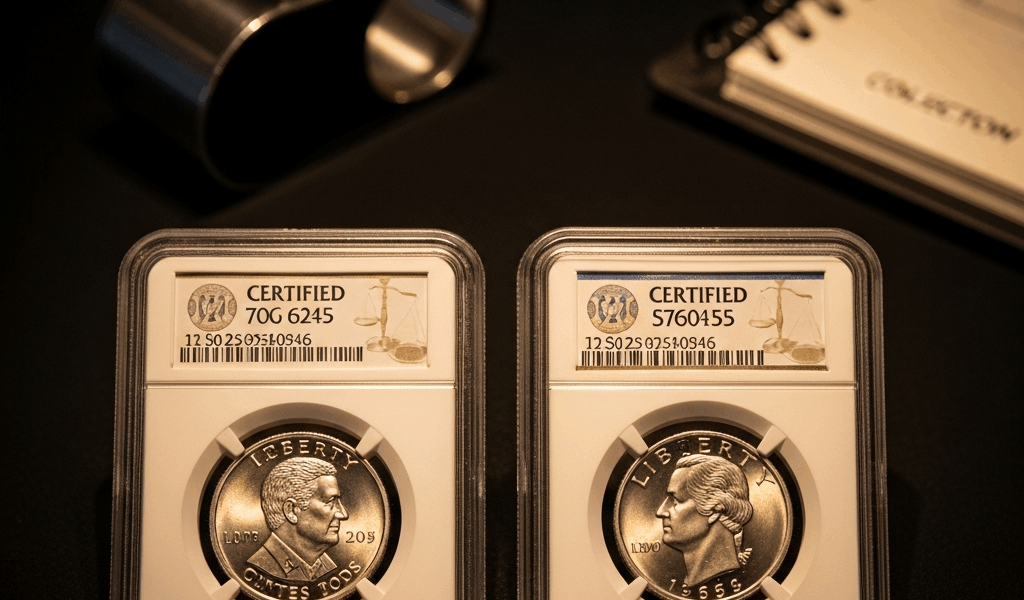
But what is the actual distinction between these two services? In essence, it’s a reputational split built around coin categories. But it’s much more than that. PCGS — Professional Coin Grading Service — owns the classic United States coin market in terms of collector preference and commands a real price premium there. NGC — Numismatic Guaranty Company — covers far broader ground: world coins, ancients, tokens, exonumia, modern bullion. Both use the same 70-point Sheldon scale. Both house coins in hard plastic slabs with serial numbers you verify online. PCGS membership runs $69 a year. NGC is $25. The technical infrastructure is nearly identical. The difference lives entirely in market perception and coin category.
That’s what makes this debate so endearing to us collectors — it’s never quite as simple as picking the “better” one. So, without further ado, let’s dive in.
Grading Standards — Is One Stricter?
Worn down by years of forum arguments about this, I eventually just started keeping my own notes on crossover results. Coins I submitted to one service after having them graded by the other. The conventional wisdom says PCGS grades stricter on classic US coins — pre-1934 material, Morgan dollars, Peace dollars, early gold. That reputation is largely earned.
I’ve cracked out NGC MS-64 Morgan dollars and resubmitted to PCGS hoping for a bump. About half got the same grade back. Occasionally I gained a point. Twice I lost one. The grading market is not a vending machine — don’t make my mistake of treating it like one.
Where the PCGS strictness reputation really bites is at key grade boundaries. MS-64 versus MS-65. MS-65 versus MS-66. A coin sitting in a PCGS MS-65 holder is generally assumed — right or wrong — to have earned that grade harder than the same coin in an NGC holder. That assumption drives auction prices. It’s circular logic that became self-fulfilling somewhere around 1995 and hasn’t loosened since.
Modern Issues — A Different Story
For modern coins — roughly 1980s onward, American Silver Eagles, Gold Eagles — NGC is broadly considered more consistent. I’m apparently someone who gets surprised by grades more than the average submitter, and NGC works for me on modern material while PCGS never quite delivers what I expect on those same submissions. The population on modern coins is massive. Grade differences come down to tiny surface marks. Turnaround has been faster at NGC on this category too, at least in my experience submitting through a dealer in Charlotte who handles both services.
World Coins and Ancients
PCGS technically grades world coins. This is still NGC’s territory. Full stop. NGC has been doing world coins and ancients for decades — their population reports for non-US material are genuinely comprehensive, and dealers who specialize here almost universally prefer the green NGC holder. I submitted a British sovereign and a handful of pre-1900 Mexican 8 reales to both services over the years. The NGC holders moved faster at better prices every single time. Not close.
Cost Comparison — Membership and Grading Fees
Probably should have opened with this section, honestly, because cost is the thing that stops most collectors from submitting anything in the first place.
NGC membership: $25 per year for basic access. No walk-in — you submit through an authorized dealer or directly as a member. Economy grading for coins valued under $300 runs around $22 per coin with current fee schedules, though that number drifts, so check their site before you send anything.
PCGS membership: $69 per year for standard membership. Their economy tier — coins valued under $499 — lands around $22–$25 per coin as well. The membership gap alone is $44 annually. At economy rates, that’s essentially two free gradings with NGC before you’ve even started comparing per-coin fees.
So when does the PCGS premium actually pencil out?
- You’re submitting classic US coins — Morgan dollars, Peace dollars, Barber coinage, early gold, Walking Liberty halves — where the blue PCGS holder demonstrably adds 5–15% to resale value
- You have a coin you believe is worth $500 or more and you’re planning to sell it — the price premium on a $1,200 Morgan dollar swallows that $44 membership difference in one transaction
- You’re buying raw coins specifically to crack, grade, and resell in the classic US market
Hobbyist submitting five or ten coins a year across mixed categories? NGC wins on pure math. Not a close call.
The Break-Even Math on a Real Example
Here’s an actual submission from 2022. A 1921-D Morgan dollar — what I thought was MS-63 condition, raw, purchased for $185 at a coin show at the State Fairgrounds in Raleigh. NGC economy submission plus membership came to roughly $47 all in. Coin came back MS-63. Sold on eBay for $240. Profit after fees: about $50. The same coin in a PCGS MS-63 holder was selling around $265 at the time. If PCGS had cost me $91 all in, I’d have cleared roughly $60. That’s $10 more. On a $185 coin. Scale that up to a $1,500 key date and suddenly the math looks completely different — but the $185 coin doesn’t care which slab it lives in.
Which Service for Which Coins
This is the section I wish someone had just handed me six years ago instead of letting me figure it out through expensive trial and error. Don’t make my mistake.
Classic US Coins — Use PCGS
Morgan dollars. Peace dollars. Barber dimes, quarters, and halves. Liberty Head nickels. Early American gold — eagles, half eagles, quarter eagles. Bust dollars. These series have deep PCGS populations and buyers who have been conditioned for decades to pay more for blue holders. Submit here. The premium is real and documented across thousands of Heritage and Stack’s Bowers auction results.
World Coins and Ancients — Use NGC
British sovereigns, German marks, Mexican silver, ancient Greek and Roman coins — anything non-US goes to NGC. Their world coin population reports are comprehensive in a way PCGS simply doesn’t match. Their attribution standards for ancients are taken seriously by the specialists who actually buy these things. PCGS doesn’t compete meaningfully in this space and, honestly, probably isn’t trying to.
Modern US Bullion — Either Works
American Silver Eagles, Gold Eagles, Platinum Eagles, First Spouse gold — both services handle these and both holders move in the market. I’ve used NGC for most of my bullion grading just to keep costs down. A 5% premium on a PCGS MS-70 Eagle exists mostly in the direct-to-consumer bullion market, not among serious numismatists — at least that’s been my read after watching completed sales for the better part of four years.
Commemoratives and Proof Sets
Either service works here. I’ve used both without meaningful difference in outcome. Price gaps for modern commemoratives between PCGS and NGC holders are minimal unless you’re dealing with a coin that has an unusually small PCGS population — which creates artificial scarcity on the pop report and occasionally inflates prices in weird ways.
The Resale Value Question
The 5–15% PCGS premium on classic US coins is real. Watched enough completed eBay auctions and Heritage sale results to stop arguing about it. A PCGS MS-64 1884-O Morgan dollar consistently sells above the same coin in an NGC MS-64 holder. Not always by a fixed amount. Not in every single transaction. But the pattern holds across enough data points that dismissing it as collector mythology doesn’t hold up.
The question — the only question — is whether that premium survives the cost of obtaining it.
For a coin selling at $150, a 10% premium is $15. Your PCGS membership already costs $44 more per year than NGC. You need three or four classic US coins annually just to break even on the membership gap before grading fees enter the picture. That math only works if you’re a frequent submitter who stays focused on classic American material.
For a coin selling at $2,000, a 10% premium is $200. The membership cost difference becomes irrelevant. Submit to PCGS. No further analysis needed.
The mistake I made early on — more than once, embarrassingly — was submitting lower-value coins to PCGS out of habit and brand preference. Eating the higher membership cost with nothing to show for it on the resale end. Grading fees are sunk costs regardless of which service you pick. Membership fees are where people quietly leave money behind on the low end of the value spectrum.
One Final Consideration — Registry Sets
Both services maintain competitive registry sets — collectors competing to assemble the highest-graded examples of a given series. If you’re building a registry set, the holder choice makes itself. You use that service’s slabs, period. PCGS registry competition is fierce and drives real price premiums on top-pop coins. NGC’s registry is active but runs at a lower temperature. If competitive collecting is your goal, that decision removes the whole debate from your hands automatically.
Bottom line: PCGS for classic US coins you intend to sell or enter into registry competition. NGC for world coins, ancients, modern bullion, and general collecting where the cost savings outweigh the holder premium. That was six years of submissions, two dealer friendships, and one painful eBay learning curve compressed into two sentences. Submit accordingly.

Stay in the loop
Get the latest global coin collector updates delivered to your inbox.