Why Mercury Dimes Reward Careful Set Builders
Mercury dime collecting has gotten complicated with all the investor noise flying around. As someone who started buying these coins back in 2008 — worst possible year economically, best possible year intellectually — I learned everything there is to know about the key dates, the design history, and what actually separates a serious set from a shoebox of silver. Today, I will share it all with you.
Silver was pushing $20 an ounce that year. Every dealer I walked past was shoving raw rolls at investors chasing spot price. That wasn’t why I was there. I wanted to understand mercury dime key dates the way a collector understands them — not as price points, but as history you can hold.
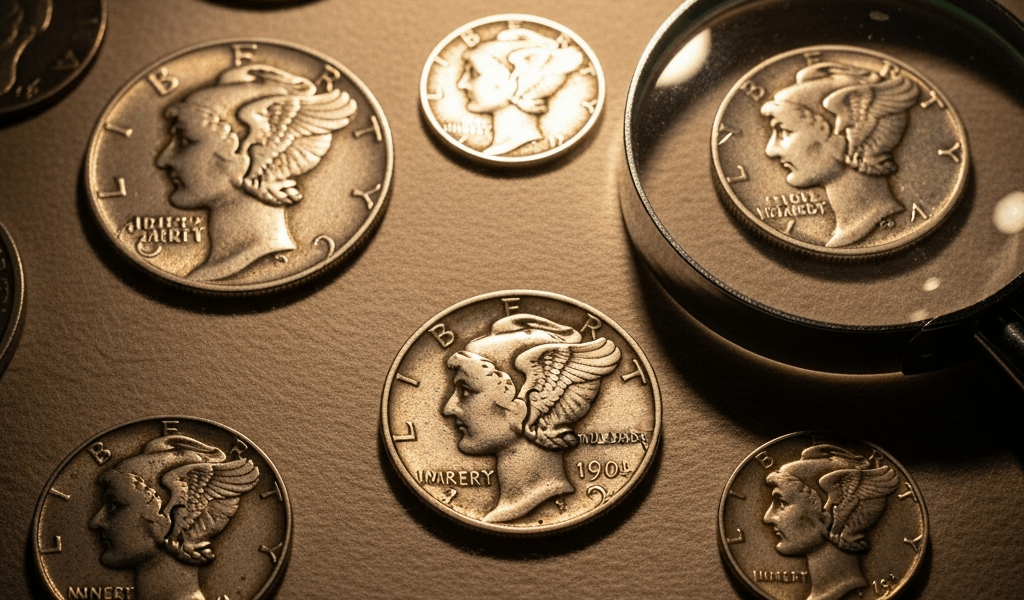
Adolph Weinman designed the series in 1916. His obverse still gets me: Liberty’s profile stripped down to essential lines, winged cap caught mid-motion like she’s going somewhere. Flip it over and you’ve got a fasces — an axe bundled with rods, Roman symbolism for strength through unity. Elegant. Sober. And for a collector, genuinely forgiving. The whole series runs 1916 to 1945. No modern restrikes. Every date and mintmark struck across three decades fits in a single pocket album.
But what is Full Split Bands? In essence, it’s a strike quality designation awarded by PCGS and NGC when the reverse bands on the fasces show crisp, distinct separation. But it’s much more than that — it’s the last major variable separating Mercury dimes beyond date and grade, and understanding it changes how you shop entirely.
That’s what makes Mercury dimes endearing to us set builders. The series is finite, affordable at entry level, and rewards study over spending. So, without further ado, let’s dive in.
The True Key Dates and What Makes Them Scarce
The 1916-D is the king. Full stop. Denver struck only 264,000 of them — a number that sounds abstract until you picture a mid-sized college football game and realize that crowd outnumbers every surviving example by a factor that makes collectors uncomfortable. Compare that to the 1941 Philadelphia issue at 175 million coins. The gap isn’t a difference in degree. It’s a different category entirely.
Probably should have opened with authentication warnings, honestly. Counterfeits exist. Some of them aren’t terrible. I’ve handled fakes showing decent color, reasonable surfaces, and striking that doesn’t immediately scream problem. The tells live in small places. The mint mark D should sit directly below the wreath on the reverse — punched cleanly, integral to the metal. What you don’t want: a D that drifts left or right, a D with blurry edges, a D that looks applied rather than struck. Get your suspected 1916-D under 10x magnification. The mark should be singular and unified. If it looks composite or reworked, walk away.
I’m apparently paranoid about this, and that paranoia works for me while casual eyeballing never does. Don’t make my mistake of skipping the loupe.
1921 and 1921-D sit in the second tier. Philadelphia hit 1,230,000 that year. Denver managed 1,080,000. Neither matches the 1916-D scarcity, but original rolls are genuinely uncommon — not collector mythology, actual scarcity. The 1921-D particularly struggles with strike quality. I’ve examined maybe forty examples over the years. Three showed Full Split Bands worth mentioning without professional grading support. Three. If you encounter a 1921-D with sharp bands, the value premium is real and defensible.
Counterfeits of 1921 and 1921-D exist but are rarer than the coins themselves — the effort-to-reward math doesn’t favor fakers here. Cleaned examples are the bigger threat. Mercury dimes clean more visibly than modern coins because the open fields catch wear fast. Cleaned 1921s have a glassy, lifeless surface. Original circulation wear shows as tiny granular changes across the fields, not uniform smooth luster loss.
Semi-Key Dates Worth Hunting in Circulated Grades
Most collectors won’t own true keys. Most won’t drop $300 on a 1916-D graded VG-10. That’s fine. Nearly complete sets built on circulated semi-keys represent some of the most satisfying work in American numismatics, and the budget stays human-sized throughout.
The 1926-S represents everything beautiful about this approach. San Francisco struck 4,220,000 that year — not rare by any measure. But that mintage landed during an economic lull, and a lot of those coins rolled into bank vaults and sat undisturbed for decades. Finding original 1926-S rolls from estate sales still happens. In VG, F, or VF grades, expect to pay $15 to $35 depending on eye appeal. That’s a legitimate set filler on a real-world budget.
1931-D and 1931-S command larger premiums. The whole year was weak — Depression economics hadn’t killed demand yet, but production collapsed. 1931-D: 3,150,000 minted. 1931-S: 3,640,000. In VF, budget $20 to $50 each. Drop to Good-through-Fine grades and you’re looking at $8 to $20. These are genuine semi-keys. Not inflated by collector myths — by actual mintage numbers.
Last year I found a VF 1926-S in a dealer’s junk box at a regional show for $18. It was labeled 1926-P. That was apparently an $18 mistake on their end and a good afternoon on mine.
I’ve never understood the shame some collectors carry about lower-grade coins. A Fine 1931-D is rarer than a mint state 1942 Philadelphia. It carries the same historical weight. It requires the same identification skills. The only real difference is someone actually used it — which makes it more authentic to me, not less.
Watch strike quality even on circulated semi-keys. 1931-S particularly struggles with crisp reverse definition. In worn grades this barely registers — bands are gone anyway. But in Fine or VF examples, prioritize eye appeal over certification numbers. A well-struck circulated coin ages better in a set than a weakly struck certified one. The grade is provisional. The appeal lasts.
Understanding Full Split Bands and Why It Matters
Full Split Bands — FB — sounds like mysterious numismatic jargon. It isn’t, once you train your eye for about twenty minutes.
Flip a Mercury dime and look at the reverse. Center of the design, the fasces sits there: rods bundled around an axe, classical Roman symbolism rendered in 17.9mm of 90% silver. At the bundle’s base, where individual rods should show distinct separation, weakly struck coins give you muddy indistinction — a solid bar where lines should be. Sharply struck coins show clear parallel lines with readable space between each rod. That clarity is FB. The bands split. You see them. That’s the whole thing.
PCGS and NGC certify FB status under 10x magnification against specific criteria. You can’t squint at a coin under a desk lamp and call it FB because you want to. Either the bands are there or they aren’t — grading services don’t negotiate on this.
Why does it matter financially? A VF-25 1941 with FB might run 20% above the same date without it. That’s a real premium, tied to production circumstances and die progression, not collector sentiment. Strike quality is measurable. Better strikes correlate with better dies earlier in their production life. That correlation holds across the series.
Hardest dates to find with FB: 1921-D tops the list, then 1931-S, then several mid-1920s San Francisco issues. Later dates — most 1940s production — generally struck better. Philadelphia 1942 in FB is almost common. 1921-D in FB is genuinely rare. If your budget allows only one FB premium purchase in the series, spend it on 1921-D.
How to Build a Complete Mercury Dime Set Realistically
While you won’t need a six-figure budget, you will need a handful of resources: a basic folder, a 10x loupe, access to at least one regional coin show annually, and patience measured in years rather than months.
First, you should buy a folder — at least if you want to stay oriented on what’s missing. A standard 1916-1945 folder runs about $8 at any coin show. That’s not a rounding error on a collector’s budget. It forces you to confront gaps visually and gives you reference as you acquire. I’ve watched collectors skip straight to slabbed sets, buying pre-graded coins at premium prices, and burn through serious money chasing perfection on dates that simply don’t warrant it.
A roll strategy might be the best option for entry, as Mercury dime collecting requires a foundation before it rewards specialization. That is because buying common dates first teaches you what good strikes actually look like before you’re spending real money on semi-keys. Pick up rolls of 1940-1945 Philadelphia and San Francisco issues from any dealer — face value plus 10-15% premium, maybe $200 total for 40-50 coins spanning six dates across two mints. You’ve filled 40% of the set and kept real money in the silver.
Sequence matters: common dates first, semi-keys next, true keys last. This isn’t just budget discipline — it’s education. You’ll develop eye appeal instincts. You’ll decide whether FB matters to you or feels like premium chasing on dates that don’t justify it.
Hunt estate sales aggressively. Mercury dimes surface constantly in old collections. Frustrated by inflated dealer prices in 2011, I started hitting local estate auctions instead — using nothing fancier than a free auction listing service and a Saturday morning. Bought a nearly complete folder for $50 because the heirs had no idea what they held. Mid-size regional coin shows reward persistence more than mega-shows do. Dealer junk boxes are underrated. The 1926-S I mentioned earlier — $18, bulk bin, incorrectly labeled. That was not an isolated incident in twenty years of looking.
This new approach to Mercury dime collecting took off among serious hobbyists several years after the series ended and eventually evolved into the methodical, date-by-date discipline enthusiasts know and practice today. The framework works because the series is finite and the variables are learnable.
Prioritize eye appeal and strike quality over grade numbers alone. A VF-30 with sharp strike and original surfaces will age better as a set piece than a VF-35 that’s been cleaned and weakly struck. Grades are provisional assessments made on a given day. Appeal is permanent.

Stay in the loop
Get the latest global coin collector updates delivered to your inbox.