Why Wheat Penny Errors Reward Patient Collectors
Wheat penny collecting has gotten complicated with all the misinformation flying around — especially online, where every circulated 1955 cent gets listed as a doubled die. As someone who dumped a full roll of pennies into a parking meter before realizing one might have been worth three hundred dollars, I learned everything there is to know about wheat penny errors the painful way. Today, I will share it all with you.
The Lincoln Wheat Penny series ran from 1909 to 1958. Over 10 billion coins. Philadelphia, Denver, San Francisco, and briefly West Point all contributed to that number. That volume alone guarantees something interesting slipped through. Overworked dies, hub doubling, metal fatigue — these weren’t flukes. They were practically inevitable once you push mint machinery hard enough during wartime production surges.
But what is a die variety? In essence, it’s a coin that looks subtly or dramatically different from its neighbors in the same year and mint run. But it’s much more than that. A single master hub — the steel punch used to create working dies — gets pressed into blank dies repeatedly. If that hub shifts mid-process, if a die gets repunched at a different angle, if the metal fatigues after millions of strikes, collectors end up with something genuinely distinguishable. Identifiable. Documentable.
This is learnable territory. Not lottery tickets. Not speculative investing. Just patient examination with a decent loupe and proper lighting.
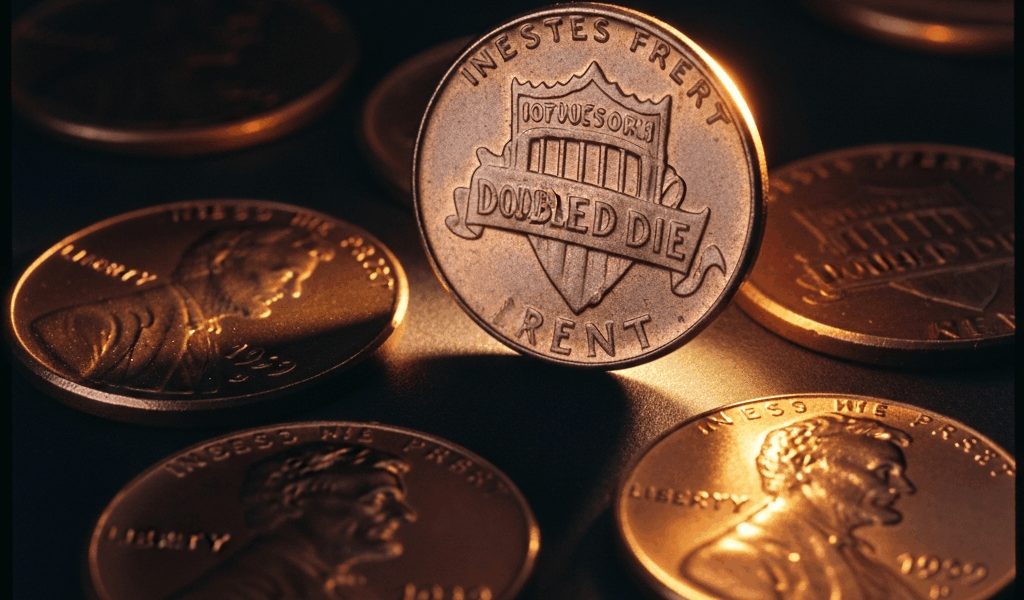
1955 Doubled Die Obverse — The One Everyone Chases
Probably should have opened with this section, honestly. The 1955 Doubled Die Obverse is the gateway error coin for most wheat penny collectors. It’s the one that makes people stop feeding meters and start carrying a magnifier to the grocery store.
The doubling is visible without any magnification — if you know where to look. LIBERTY shows dramatic letter separation on the left side. IN GOD WE TRUST duplicates visibly across the upper field. The date itself, 1955, appears as a faint ghost image hovering just above the struck numerals. A 5x loupe clarifies everything. A 10x makes the error completely unmistakable.
Here’s the mechanical reality behind it. The master hub pressed into the working die, shifted slightly, then pressed again. Both images transferred to the die face permanently. Every single coin struck from that die inherited the doubling — which is why examples still turn up in old rolls today, six decades after leaving the Philadelphia Mint.
I learned the difference between hub doubling and mechanical doubling the hard way. Mechanical doubling happens during the actual strike when a coin shifts against the die after initial contact. Hub doubling happens earlier — at the die-manufacturing stage, before a single coin gets struck. That distinction matters enormously because graders separate them immediately, and one is worth significant money while the other is basically worth one cent.
Worn photographs and bad lighting will hide a genuine 1955 Doubled Die every time. You need direct overhead light and a clear angle. Rotate the coin slowly. Watch how the doubled letters catch light differently than the surrounding die-struck field. A smartphone camera won’t show you this. You need to hold it, rotate it, examine it properly.
Counterfeits exist. Altered coins exist. Before submitting anything to PCGS or NGC, handle your suspected specimen with cotton gloves, store it in an acid-free flip, and document everything — written observations, date-stamped photographs from multiple angles. That coin deserves that level of respect if it’s genuine.
1922 Plain — When Denver Forgot to Strike the D
The 1922 Plain penny represents die wear rather than a striking error. That’s what makes it endearing to us variety collectors — the story behind it is almost absurdly mundane. Denver’s reverse die simply wore down until the D mintmark disappeared entirely.
Frustrated by a shortage of working dies in 1922, Denver’s mint staff pushed existing reverse dies well past their useful lifespan. The D mintmark, originally struck into the die surface, eroded from repeated use across hundreds of thousands of strikes. Eventually coins came off the press bearing no visible mintmark whatsoever — seemingly indistinguishable from Philadelphia cents. Three die pairs produced Plain variants that year, each with tight identifying characteristics.
Authentication hinges on one specific detail. The strongest 1922 Plain varieties show a weak reverse paired with a strong, crisp obverse. If you find a 1922 with no D and both sides look equally sharp, you’re probably holding a normal cent or an altered coin. The diagnostic matters. Graders know immediately.
This new classification took hold several years after these coins entered circulation and eventually evolved into the variety attribution system specialists know and reference today. Some catalogs list the 1922 Plain separately from true striking errors — because technically nothing went wrong at the moment of striking. The problem occurred upstream, during die maintenance. Know which type you’re examining before you submit anything.
Lesser-Known Wheat Errors Worth Examining Closely
1909-S VDB Mintmark Placement — The San Francisco mint placed the S mintmark in varying positions across the 1909 VDB run. Some appear higher, some lower, some tilted at a slight angle. These are die varieties, not rare coins outright, but they represent observable differences worth documenting. A 10x loupe and a cataloged reference image are all you need to start comparing.
1943 Copper Penny — Wartime zinc rationing pushed the mint to strike 1943 cents from zinc-coated steel blanks. A handful of copper planchets escaped into the hopper before the changeover. These aren’t errors in the traditional sense — they’re off-metal strikes. If you ever find a 1943 penny that isn’t magnetic and shows copper coloring, document it immediately. Fakes are everywhere, but genuine specimens are worth serious authentication effort.
1944 Steel Penny — The inverse scenario. Leftover 1943 steel blanks got struck in 1944 after the mint returned to copper production. Same mechanism, reversed years. Off-metal varieties require weight testing, magnet testing, and professional evaluation before anyone should get excited. Handle with care — literally.
Repunched Mintmarks — Several years show mintmarks struck twice at slightly offset angles, creating visible doubling under magnification. 1918-S and 1955-D both display these varieties. The diagnostics are tight and entirely visual. Compare against reference photographs from CONECA or major cataloging sources before submitting anything.
How to Examine Wheat Pennies Without Destroying Them
Handling matters more than most beginners realize. Bare fingers leave oils and mild acids on metal surfaces. That damage compounds over decades into something irreversible.
While you won’t need a full conservation laboratory, you will need a handful of inexpensive supplies. Cotton gloves run about three dollars for twelve pairs from any numismatic supplier. I’m apparently particular about lint-free gloves and the Lindstrom brand works for me while cheaper cotton versions never quite fit right. Don’t make my mistake of grabbing craft store gloves — they shed fibers onto coin surfaces.
Magnification requires a real investment, at least if you want to reliably identify genuine errors. A basic 5x loupe handles broad doubling and mintmark varieties. A 10x reveals die characteristics, wear patterns, and fine details that separate genuine errors from altered coins. I use a Zeiss jeweler’s loupe — roughly thirty-five dollars from a local coin shop — and it’s outlasted at least five cheaper models I burned through previously. That was around 2019. Still using the same one.
A clip-on LED ring light designed for macro work might be the best option, as wheat penny examination requires precise directional illumination. That is because flat overhead light kills shadow contrast entirely — and doubling is essentially a shadow phenomenon. Position your light source at roughly 45 degrees to the coin face, then rotate slowly. Doubling appears as light-and-shadow separation between the primary and ghost images. Die cracks appear as raised lines where metal filled fractures in the die. Twelve dollars for a clip-on ring light changes everything about your examination setup.
Document everything before any grading submission. Date-stamped photographs from at least three angles, written observations about doubling direction and intensity, notes on luster condition and wear. A professional grader benefits from your detective work. That documentation also protects you — you have a clear record of exactly what you submitted and what condition it was in beforehand.
Storage demands acid-free materials without exception. Avoid PVC flips — those older cloudy plastic holders leach chemicals directly onto coin surfaces over time. Use archival Mylar 2×2 holders or certified slabs. Your local coin shop stocks these. Cost is negligible. The preservation is essentially permanent.
So, without further ado, let’s talk about community resources — because collector forums accelerate learning faster than anything else. Variety Vista, operated by CONECA, catalogs thousands of error and variety attributions across the entire wheat penny series. Online communities dedicated specifically to wheat penny collecting connect specialists who’ve examined hundreds of genuine examples. Before assuming you’ve found something significant, post detailed photographs there first. Honest feedback from experienced collectors saves submission fees and considerable embarrassment.
Five years into this hobby, I’ve submitted exactly four coins for professional grading. Three came back ungraded — common varieties or damaged specimens I’d misjudged. One genuine 1955 Doubled Die returned a certified grade. That ratio is completely normal. Learning to recognize what’s actually in front of you — what’s genuinely valuable versus what’s just interesting — costs nothing except time and attention. Honestly, that’s where the real reward lives anyway.

Stay in the loop
Get the latest global coin collector updates delivered to your inbox.