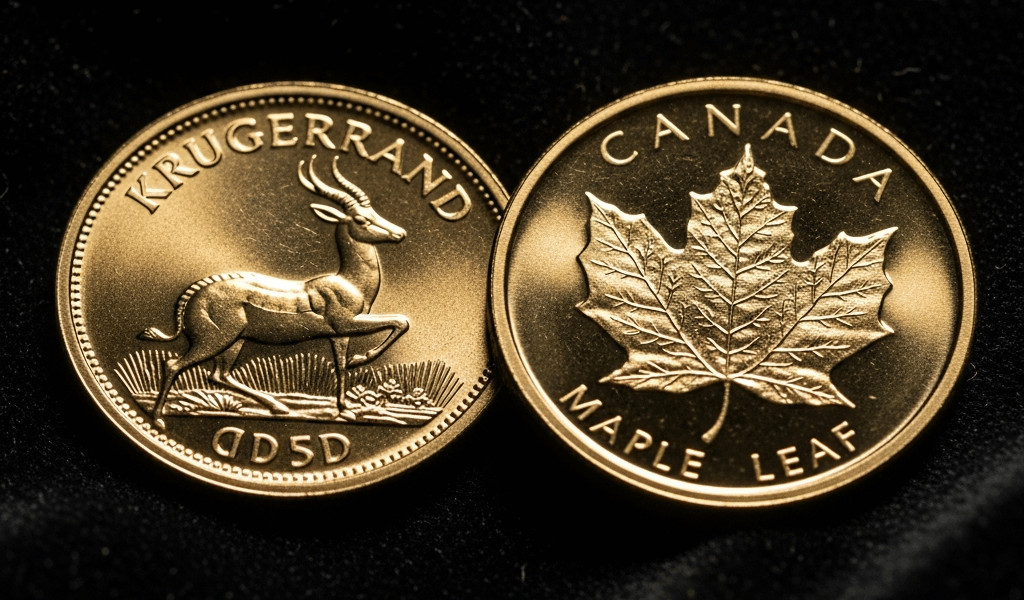
You have decided to add a gold coin to your collection and narrowed it down to two of the most recognized bullion coins on the planet — the South African Krugerrand and the Canadian Gold Maple Leaf. Both contain one troy ounce of gold. Both are globally liquid. The similarities end there, and the differences matter more than most dealers will tell you.
Purity: 22 Karat vs 24 Karat
The Krugerrand is 22-karat gold — 91.67% pure gold alloyed with copper. The Maple Leaf is 24-karat — 99.99% pure gold, one of the purest gold coins minted anywhere. Both contain exactly one troy ounce of actual gold content, but the Krugerrand is physically larger and heavier because of the copper alloy. The Krugerrand weighs 33.93 grams total versus the Maple Leaf’s 31.10 grams.
The practical difference: the copper alloy makes the Krugerrand harder and more scratch-resistant. Pure 24-karat gold is soft — Maple Leafs show handling marks more quickly. The Krugerrand’s distinctive orange-gold color comes from the copper alloy, while the Maple Leaf has the brighter yellow of pure gold. Neither is objectively better — this is aesthetics and handling preference.
History and Collector Significance
The Krugerrand was the world’s first modern gold bullion coin, introduced in 1967 by the South African Mint to market South African gold internationally. It was the coin that created the modern bullion market. During the 1970s and 1980s, the Krugerrand accounted for roughly 90% of the global gold coin market. International sanctions against apartheid-era South Africa banned Krugerrand imports in many Western countries during the 1980s, which opened the market for competitors.
The Maple Leaf launched in 1979 — directly capitalizing on the Krugerrand sanctions. The Royal Canadian Mint positioned it as the pure-gold alternative for investors who could no longer buy Krugerrands. It succeeded immediately and has remained one of the top three bullion coins globally ever since. Collecting both tells the story of how political events shaped the modern gold market.
Premium Over Spot and Liquidity
Both coins trade at low premiums over the gold spot price — typically 3 to 6 percent from major dealers. The Maple Leaf sometimes commands a slightly higher premium due to its 99.99% purity, which certain markets (particularly Asian markets) prefer. The Krugerrand’s premiums are marginally lower but the spread between buy and sell price is comparable.
Liquidity is essentially identical. Both are recognized and accepted by every major gold dealer, refiner, and exchange worldwide. You will never have trouble selling either coin at fair market value. The Krugerrand has a slight edge in European markets due to longer market presence. The Maple Leaf is marginally preferred in North American and Asian markets.
Security Features
The Maple Leaf has an edge in anti-counterfeiting technology. Since 2013, the Royal Canadian Mint has included Bullion DNA — a micro-engraved security mark on each coin that can be verified by dealers with the appropriate reader. The Maple Leaf’s radial lines on the background are also precision-machined at a level that is extremely difficult to counterfeit.
The Krugerrand relies on weight, dimensions, and the distinctive copper-gold color for authentication. No embedded security technology comparable to Bullion DNA. For collectors buying from established dealers, this difference is minimal. For collectors buying secondary market or from less established sources, the Maple Leaf’s built-in authentication provides an extra layer of confidence.
The Collector’s Decision
Buy the Krugerrand if you value the historical significance of the coin that created the modern bullion market, prefer the warmer copper-gold color, and want slightly better scratch resistance for handling. Buy the Maple Leaf if you want maximum purity, built-in security verification, and the brighter yellow gold appearance. For a balanced collection, own both — they represent the two most important chapters in the modern gold bullion story.




Stay in the loop
Get the latest global coin collector updates delivered to your inbox.