Coin Albums vs Folders vs Capsules — Which Storage System Actually Works
Coin storage has gotten complicated with all the conflicting advice flying around. As someone who’s rebuilt three separate collections over the past decade — including one I basically destroyed through bad storage decisions — I learned everything there is to know about keeping coins safe. Today, I will share it all with you.
But what is a coin storage system, really? In essence, it’s whatever keeps your coins from deteriorating. But it’s much more than that. It’s a decision that determines whether your collection looks pristine in thirty years or turns into a box of regret.
So, without further ado, let’s dive in.
Budget folders are where most people start. I’m talking cardboard 2×2 flips — the kind you grab 100 of for around $14.99 on Amazon. Dust protection, decent portability, stack nicely in shoeboxes. They’re temporary by nature, though. Once you’re past fifty coins, folders start feeling embarrassingly casual.
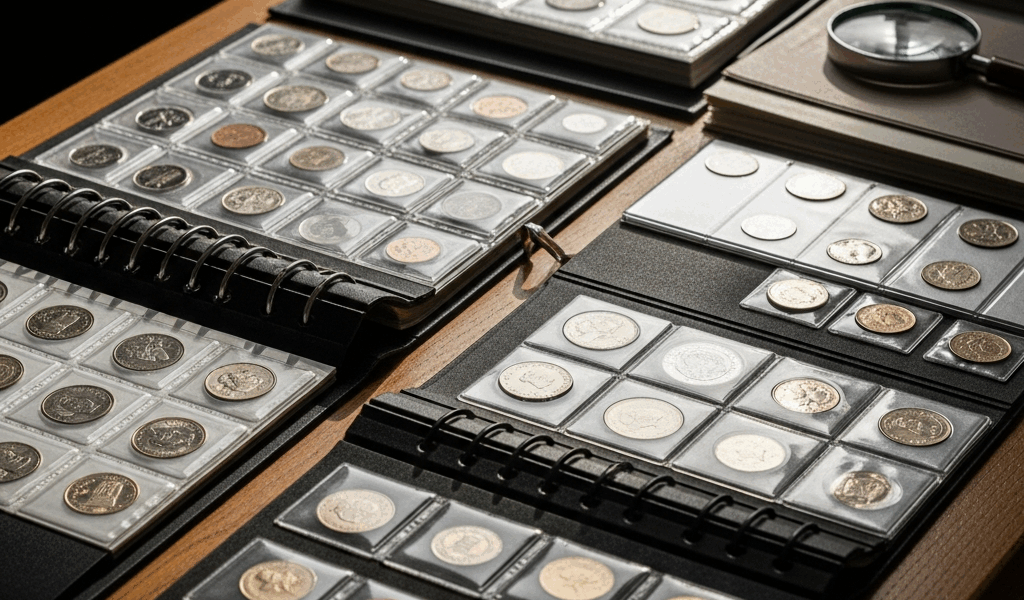
Albums are the middle ground — display-quality binders with built-in pages you can flip through without touching anything. They make sense somewhere between 50 and 500 coins. That’s what most collectors graduate to. That’s what makes albums endearing to us hobbyists who want to actually show people what we’ve built.
Capsules are the premium tier. A $200 Morgan dollar doesn’t go in a folder. It lives alone in an airtight capsule, sealed against humidity and fingerprints. Probably should have opened with this section, honestly — capsules deserve serious attention and we’ll get there.
The mistake I see constantly is mismatching storage to coin value. Don’t make my mistake. A raw 1950s Washington quarter belongs in a folder. A PCGS MS-67 specimen belongs in something bulletproof. Scale your storage to what you’re protecting, full stop.
Best Coin Albums for US Collections
Dansco might be the best option, as coin storage requires archival-grade consistency over decades. That is because cheaper materials — acidic cardstock, PVC-adjacent plastics — start degrading your coins around year five or six without you even noticing. Dansco’s 7270 album handles Eisenhower dollars. Their 7171 is built for Morgan dollars. New models run $30 to $60 depending on configuration, and they hold resale value surprisingly well.
I’m apparently a Dansco person and their albums work for me while Whitman folders never quite felt substantial enough for anything I cared about. That said, Whitman folders are genuinely solid for beginners — their Lincoln cent albums do exactly what they promise for under $20. The cardstock is decent. Not Dansco-level, but decent.
Littleton albums sit between those two in both price and quality. Clean design, acid-free materials, weirdly underrated. They don’t get talked about much. They should. If you’re building a modest collection methodically and don’t want to pay Dansco prices, Littleton is worth a serious look.
Here’s what actually separates good albums from mediocre ones: material composition, not appearance. PVC flips and acidic cardstock create a slow-motion disaster. Archival-grade albums — true archival, not marketing-speak archival — run $35 to $55. The difference between a $20 album and a $45 one is literally decades of preservation. Spend the extra money.
Best Storage for World and Ancient Coins
World coins are trickier than US coins. Different sizes, different metals, different ages — a mixed international collection needs genuine flexibility, not a system designed around standard US denominations.
Saflip 2×2 holders changed everything for me when I started picking up British and Commonwealth pieces. These are polystyrene — PVC-free — little capsules, maybe $0.10 per holder when you buy in bulk. They come in single and split compartments. They accommodate almost any circular coin without forcing it. I built an entire world coin section using nothing but Saflips and a simple filing box from Staples. That was 2019, and everything still looks clean.
Lighthouse albums go the opposite direction entirely — premium presentation, museum-adjacent quality. Their Optima line runs $80 to $150 and uses archival pages with viewing windows on both sides. Multiple insert sizes accommodate different coin diameters specifically. If you have a serious world collection with pieces worth displaying properly, Lighthouse is the answer.
Ancient coins deserve their own paragraph. Numismatic Storage Systems makes capsules sized for ancients — irregular shapes, worn edges, denominations that won’t sit right in modern holders. Graded ancients live in their slabs already, so this matters most for raw pieces you’re keeping ungraded.
The non-negotiable rule for world coins is PVC avoidance — at least if you want your coins to survive the next decade looking like coins. Those cheap vinyl 2x2s at flea markets? Poison. The plasticizer leaches directly onto coin surfaces and creates a green-brown film. I made this mistake with four British florins back in 2017. The damage was permanent. Check every product description before buying. Polystyrene, Mylar, and archival plastics are safe. Vinyl is not.
Mistakes That Damage Your Coins
First, you should eliminate every PVC flip from your collection — at least if you have any coins you’d actually miss. I mentioned this already. I’m mentioning it again because people keep buying them. The chlorine in vinyl migrates to metal surfaces. Your beautiful coin starts looking mottled and diseased. Don’t make my mistake.
Touching coins with bare hands is mistake two. Skin oils are acidic. They corrode metal gradually, invisibly, until one day you notice fingerprints etched into an obverse that used to look perfect. I have a Mercury dime — a nice one, 1942, Full Bands — that now has my thumbprint permanently visible. Cotton gloves cost $6 for a pack of twelve. Handle coins by the edges anyway, even with gloves.
Mistake three is cleaning. Coins are not dishes. Scrubbing removes patina. Polishing scratches surfaces microscopically. Commercial cleaners do both simultaneously. A cleaned coin loses collector value almost entirely — a genuinely encrustated coin that needs intervention should go to a professional conservator, not your kitchen sink.
Humid environments are mistake four. Basements, bathrooms, attics in Florida — all terrible. Moisture accelerates oxidation dramatically. I keep a $22 AcuRite humidity monitor in my collection cabinet. Anything above 50 percent gets a silica gel packet added immediately. Raw coins need climate-controlled storage. Graded slabs have some protection, but not infinite protection.
Mistake five is overcrowding holders. If a coin barely squeezes into an album slot, there’s surface pressure every time you move the album. Coins should sit comfortably with no contact friction. Size your storage to your actual coins — never the reverse.
The right system depends entirely on your collection’s scope and what it’s worth. Folders for casual modern collecting. Albums for mid-range display. Capsules for anything you’d genuinely insure. Match the storage to the coins, and you’re set for decades. Mismatch them, and you’ll be writing forum posts asking if damage is reversible. It usually isn’t.



Stay in the loop
Get the latest global coin collector updates delivered to your inbox.