 Free CalculatorKarat Pro: Gold CalculatorKarat Pro— Gold Calculator for Coin CollectorsDownload for iPhoneGet it on Google Play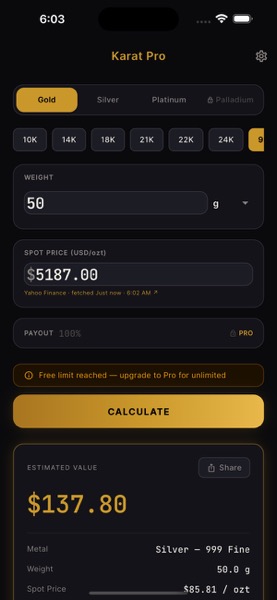
I spent forty-five minutes at a regional coin show last month watching a young collector talk himself into overpaying for a worn 1908 Liberty Head double eagle. The dealer’s spot-price card was three days old. The collector’s phone calculator wasn’t doing the math right because he’d entered the weight in grams instead of troy ounces. He paid $187 over current melt — a small premium for a numismatically uninteresting example. The lesson, watched in real time: a collector who can’t do live precious-metal math at a show is making decisions on stale data, and the dealer always has the freshest spot.
That’s the problem Karat Pro solves. It’s a mobile gold calculator that pulls a current spot price, lets you specify karat and weight, and gives you a live melt value in under ten seconds. After two months of using it at shows, estate sales, and a few coin shop visits, here’s the honest field report from a numismatic perspective.
What the App Actually Does
Karat Pro takes three inputs and produces a melt value:
- Current spot price of gold (auto-fetched, refreshable)
- Karat of the item (10K, 14K, 18K, 22K, 24K — or custom purity for coin compositions)
- Weight of the item (grams, troy ounces, pennyweights, or grains)
Output is the gold-content value of the item. For a coin collector, this is the floor — the minimum value of the piece based purely on its precious-metal content. Anything you pay above this floor reflects numismatic value (rarity, grade, history, demand) or dealer markup. Knowing the floor changes how you negotiate.
Walkthrough: Evaluating a 1908 Saint-Gaudens Double Eagle
To show how this works in practice, here’s the evaluation I ran on a 1908 Saint-Gaudens (Liberty Head reverse, “No Motto” obverse) offered at a recent show for $3,150.
The coin’s specs:
- Composition: 0.900 fine gold (90% gold, 10% copper)
- Total weight: 33.4361 grams (1.0750 troy oz)
- Actual gold weight (AGW): 0.96750 troy oz
- Karat equivalent: 21.6K (since 90% pure)
In Karat Pro, I selected the custom-purity option (not standard 21.6K, but close enough that “21K” works for a quick estimate), entered the weight, and let it calculate against the day’s spot price. Spot that morning was running about $2,915/oz. The app returned a melt floor of approximately $2,820.
So the offering price of $3,150 was about $330 above pure melt. For a 1908 Saint-Gaudens — common date, AU58 estimated grade — that premium is on the low end of fair. Most price guides show $3,200-3,400 retail for a clean AU58 No Motto example at those gold levels. The dealer was offering a slim margin over melt because he probably bought the coin under a tough cash-flow week and needed to move it. I bought it.
The math took 12 seconds with the app. Without it, I’d have either accepted the dealer’s claim about premium-over-melt at face value (rarely a good idea) or pulled up a spot site, done long division on weight conversion, and used the time the dealer wanted for closing the deal.
Where Karat Pro Beats Dealer-Site Price Checkers
The major dealer sites (APMEX, JM Bullion, SD Bullion) post live spot prices, and they’re the resource most collectors default to. They have a few weaknesses:
They quote retail-buy prices, not melt math. Their listed buy price for a 1908 Saint-Gaudens will be a percentage above melt — typically 5-15% in normal markets, more during shortages. Useful information but not the floor calculation. Karat Pro gives you the actual gold-content math separately, which is the negotiating baseline.
They need internet at the show. Coin show venues often have spotty cell reception in convention hall basements. Karat Pro caches the last-fetched spot price and lets you continue evaluating without signal. The price is older the longer you go without refresh, but you can work for hours without a connection.
They don’t handle non-standard purities. A 1908 Saint-Gaudens is 90% pure. A British sovereign is 91.67%. A Krugerrand is 91.67% but with a copper alloy that makes the coin heavier than the gold weight implies. Dealer sites might let you select “Krugerrand” from a list, but for an uncommon coin (a 19th-century Greek sovereign, a Latin Monetary Union 20-franc) you’ll be doing manual math. Karat Pro‘s custom purity entry handles anything.
They take time. A dealer-site lookup typically requires opening a browser, navigating to the price page, finding the right coin in a long list, and reading the price. Twenty to forty-five seconds, easily. Karat Pro is six taps and ten seconds.
The Limitations to Know Before You Trust It
Honest assessment:
It doesn’t know numismatic value. Karat Pro is a gold calculator, not a coin grading or pricing service. A 1909-S VDB Lincoln cent is worth thousands due to rarity, not metal content. Don’t use Karat Pro to evaluate semi-key or key date coinage where the numismatic premium dwarfs the melt value. For most coins worth less than $500, melt is the right reference. Above $500, you need numismatic references too.
The spot price feed has lag. The app refreshes spot from a public feed. In normal markets the lag is a few minutes — meaningless for valuation. During major gold-price moves (a Fed announcement, a geopolitical event), spot can move several dollars per ounce in 30 seconds. A 12-minute-old quote can be off by $5-$20/oz. For a 33-gram coin that’s a $5-$20 swing on the melt floor. Not catastrophic but worth knowing.
Weight precision matters and the app trusts your input. If you weigh a coin on a poorly-calibrated scale or fat-finger the weight by 0.01 grams, the calculator faithfully computes a wrong answer. Use a calibrated jewelry scale (0.01g precision minimum). Coin scales are $20 on Amazon — not a serious investment for someone evaluating $1,000+ pieces.
It’s a tool, not a substitute for knowing the coin. The fastest gold calculator in the world doesn’t help if you can’t tell a struck counterfeit from a genuine 19th-century gold piece. Authentication remains your problem. Karat Pro lets you do the math faster after you’ve confirmed the piece is genuine.
GOLD CALCULATOR APPKarat Pro: Gold CalculatorRun the math at your next coin showDownload for iPhoneGet it on Google PlayOther Situations Where Karat Pro Earns Its Keep
Beyond the coin show floor, several scenarios where the calculator pays for itself:
Estate sale evaluations. When you’re brought in to evaluate an estate (or buying from one), most of the inventory will be jewelry rather than collectible coinage. A pile of mixed-karat jewelry — 10K class rings, 14K wedding bands, an 18K pocket watch case, a couple of 22K gold pieces from international travel — needs piece-by-piece math. The app handles karat changes faster than any spreadsheet I’ve used.
Krugerrand and modern bullion lots. Even though most modern bullion is sold at established premiums over melt, knowing the actual melt floor on a lot lets you spot when a dealer’s premium is inflated. A standard 1-oz Krugerrand at $50 over spot is reasonable. A 1-oz Krugerrand at $200 over spot in a stable market means the dealer thinks you don’t know.
Sovereigns and small foreign gold. British sovereigns (0.2354 oz AGW), French 20-franc coins (0.1867 oz AGW), Latin Monetary Union pieces, Swiss vrenelis. Each has a specific gold content. Memorizing all of them isn’t realistic; computing them on the fly is.
Pre-1933 US gold. The $2.50 Indian, $5 Half Eagle, $10 Eagle, $20 Double Eagle each have distinct gold contents. For collectors who handle pre-33 US gold occasionally rather than full-time, having the math at hand is a real convenience.
Verifying a buyer’s offer. If you’re selling rather than buying, knowing the melt floor of what you’re selling lets you evaluate buy offers. A dealer offering 90% of melt for a non-numismatic gold lot is fair. An offer of 70% of melt means he’s hoping you don’t have an app.
Comparing to Web-Based Calculators
A few web-based melt calculators exist (CoinFlation, NGC’s melt page, several dealer-site calculators). All work but require browser sessions. The advantages of a dedicated mobile app:
- Faster launch (one tap vs browser navigation)
- Works in poor signal areas after initial spot fetch
- Doesn’t require entering coin name from a dropdown — just karat and weight
- No ads, no popups, no cookie banners interrupting the workflow
The disadvantage: mobile apps don’t have the deep coin databases that some web tools include. If you need to know “the gold content of a 1907 Indian Head $5” without measuring, a web tool with a coin lookup is faster. Karat Pro requires the weight as input.
Pricing and Pay-Wall Behavior
The app is free to install. Core calculation is unlimited at the free tier. Some advanced features (saving calculations, multiple-piece batch calculations, custom price alerts) are behind a premium tier at a modest one-time price. For occasional show use, the free tier covers everything you actually need.
Workflow at a Coin Show — The Two-Minute Drill
The pattern I’ve settled into:
- Walk up to the dealer’s table. Glance at his spot card. (Is it from this week? Last week? Today’s date?)
- Pick up a piece of interest. Authenticate visually (no magnetism check unless suspicious, weight feel check if I’ve held the type before).
- If serious about the piece, ask to weigh it. Most dealers have scales; if not, my own scale stays in my bag.
- Open Karat Pro. Refresh spot (one tap). Enter karat (already in recent if it’s a common purity) and weight.
- Quote the melt floor mentally. Compare to dealer’s asking price.
- If the premium is reasonable for the grade and rarity, negotiate from there. If the premium is high, ask the dealer how they arrived at the price. Most reasonable dealers will adjust toward melt-plus-fair-margin when they realize you know the numbers.
The whole evaluation takes about two minutes per piece including authentication. Without the app, the same evaluation runs five to seven minutes — long enough that some dealers get impatient and you lose the buying window.
For Whom This Is Worth Installing
The app is most valuable for:
- Active coin show attendees, especially those who handle gold
- Estate sale evaluators
- Coin dealers’ apprentices learning to do quick math
- Collectors who buy from miscellaneous-lot sellers (eBay, Craigslist, estate auctions)
- Anyone who handles pre-1933 US gold or world gold coinage
Less critical for:
- Strict numismatic collectors who only buy slabbed coinage at established grade-based prices (where melt math is rarely the constraint)
- Type set builders who already know the gold content of their target coins by memory
- Dealers and bullion investors who use professional-grade spot feeds and inventory systems
For most collecting situations between the strict numismatic top end and the bullion-only bottom end, having a fast gold calculator in your pocket changes how you evaluate offers. Whether it’s worth installing for any individual collector depends on how often you handle gold and how confident you are in mental math under negotiation pressure.
Free Gold CalculatorKarat Pro: Gold CalculatorLive spot price + karat + weight = melt value in seconds. Works offline once spot is fetched. Bring it to your next coin show or estate evaluation.Download for iPhoneGet it on Google Play



Stay in the loop
Get the latest global coin collector updates delivered to your inbox.