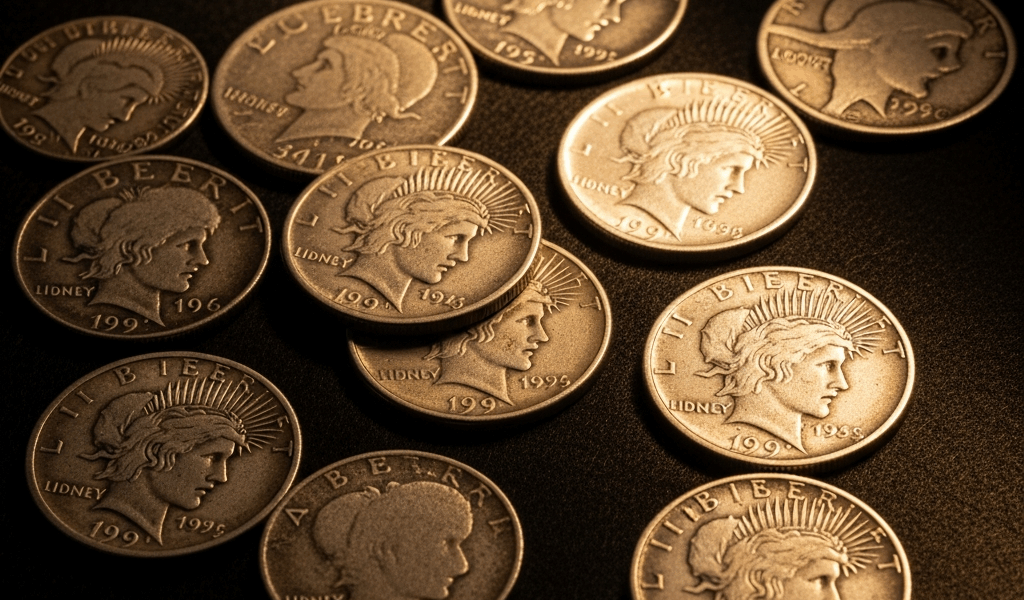
Peace Dollar Date Collecting Has Gotten More Complicated With All the Misinformation Flying Around
As someone who spent three years building a Peace Dollar date set the wrong way, I learned everything there is to know about which dates actually matter — and which ones will quietly drain your budget while sitting at melt value. Today, I will share it all with you.
But what is a Peace Dollar, really? In essence, it’s a 90% silver dollar struck between 1921 and 1935, designed by Anthony de Francisci, honoring the end of World War I. But it’s much more than that. Three mints struck these coins: Philadelphia (no mint mark), Denver (D), and San Francisco (S). Mintages swung wildly — from under 2 million on some S-mint issues to nearly 87 million on common Philadelphia dates. On paper, sorting valuable from ordinary sounds simple. It isn’t.
Circulation patterns chewed through certain dates. Melting events wiped out others. Strike quality varied so dramatically across facilities that the same “grade” on two different coins can mean completely different things to a serious collector. Most articles about Peace Dollars open with the 1921 high relief and then pivot straight to bullion premiums. That leaves a massive gap for anyone pulling coins from an estate box or a bulk lot at an antique mall. You find a 1927-S. You pull a 1934-S from a roll. You assume they’re common because nobody warned you otherwise. Don’t make my mistake.
So, without further ado, let’s dive in.
The 1921 High Relief — First Year, Distinct Design
Start here because it genuinely matters. The 1921 is visually distinct from every Peace Dollar struck after it — and that distinction is permanent. De Francisci’s design went through a significant revision after the first year. Shallower relief. Different field geometry. The revision stuck for the remaining fourteen years of the series.
The 1921 high relief shows sharper hair definition across Liberty’s cheek and forehead. Reverse lettering sits in a noticeably different style. Eagle breast feathers are crisper, more individualized. The field-to-device contrast is more dramatic — you can feel it under a loupe even on a circulated example. A worn 1921 still reads like a first-year coin if you know what you’re looking at.
Two reasons this matters practically. Collectors building a complete type set need one high-relief example, and they’ll pay accordingly regardless of grade. Also, well-circulated examples command premiums because the design work itself exists in smaller numbers than the lower-relief dates that followed. A VF-30 1921 will outprice a VF-30 1927 by 30 to 50 percent — depending on eye appeal and strike sharpness. That’s not sentiment. That’s the market working correctly.
Typical strike characteristics on the 1921 include complete definition on Liberty’s facial features and consistent eagle wing detail. Weak spots exist — the eagle’s leg and talon come out soft on some examples — but overall sharpness from 1921 strikes beats later issues broadly. Watch for hairlines on the cheek. Cleaned 1921s show them clearly under raking light, and that surface damage eliminates the premium instantly. Original luster is everything here.
What makes a 1921 valuable beyond metal content
The design novelty accounts for roughly 30 to 40 percent of the numismatic premium on a circulated 1921. The rest is surfaces and eye appeal. A VF-35 example with untouched fields and a strong strike reaches $180 to $250 at a regional show — I’ve seen it happen twice in the last eighteen months. The same date, cleaned or weakly struck, sits at $120 to $140. The difference is whether a collector sees it as a type coin or a leftover silver round. Original surfaces make that call.
San Francisco Issues Collectors Overlook in the Middle Years
Probably should have opened with this section, honestly. The 1927-S and 1928-S are the sneaky scarcities of the entire Peace Dollar run, and almost nobody talks about them outside dedicated numismatic circles.
Mintage numbers tell you nothing useful here. The 1927-S shows 866,000 pieces on record. The 1928-S recorded 1,632,000. Those figures suggest abundance. They don’t tell you that San Francisco struck these coins on worn dies under inconsistent pressure — that weak strikes are the norm, not the exception. Full-cheek definition and crisp eagle breast feathers? The exception. That’s what makes mid-series S-mint coins endearing to us date collectors — finding a sharp one feels like actual discovery.
I’m apparently a slow learner, and the hard-way approach works for me while shortcuts never do. Six months searching for a 1927-S in AU-55 or better with original luster. Six different dealers. Three regional shows. Found exactly two candidates — both priced between $380 and $450. A 1925-S in the same grade runs $200 to $280. Why the gap? The 1925-S had triple the mintage and superior striking conditions. More high-grade survivors exist. The market reflects that reality cleanly.
Your typical mushy 1927-S or 1928-S shows soft edges on Liberty’s cheek, incomplete definition on the eagle’s breast feathers, flatness across the hair curls. The reverse eagle leg is often barely outlined. These coins look problem-free at first glance — no cleaning, no obvious damage — but strike quality alone knocks them back a grade or two on any experienced collector’s desirability scale.
A well-struck S-mint from this period shows:
- Complete hair curl definition on Liberty’s forehead
- Full roundness to both cheeks without flatness
- Individual feather separation on the eagle’s breast
- Sharp talon detail on the reverse
- Consistent field luster across both sides
When you find one like that, it’s genuinely scarce — not just conditionally scarce in the abstract sense. Collectors who know the series pay accordingly. The market has priced this in even if the mintage figures don’t advertise it.
The 1934-S and 1935-S — Final Years That Vanish in AU
These two dates close out the series. That emotional finality matters to type collectors completing a set — the last-date appeal is real and measurable at shows. That appeal combines with genuine high-grade rarity to create serious price jumps once you cross into AU territory.
The 1934-S mintage was 1,011,000. The 1935-S — final year of the series — recorded 1,964,000. In circulated grades, VF-25 through VF-35, both trade for $95 to $140. That’s maybe 10 to 15 percent above melt. Cross into AU-50 territory and the premium explodes. An AU-55 1934-S with original luster runs $350 to $475 depending on certification and dealer. That was a $95 coin fifty grades ago.
Depression-era circulation was merciless — coins from the final years spent years in active use before anyone thought to set them aside. Few were preserved untouched. Even fewer kept the undisturbed mint bloom that AU grades demand. Cherrypicked high-grade examples surface occasionally, but the population is thin enough that prices reflect genuine conditional scarcity rather than manufactured collector demand.
The 1935-S carries extra weight as the series finale. Some collectors treat it as a mini-key, especially AU and above. Asking prices of $450 to $600 for AU-55 examples at established dealers are common — I’ve watched a raw AU-55 sell for $520 at a mid-sized Midwest show. Not melt value. Conditional scarcity meeting finality appeal, in one coin.
How to Evaluate Eye Appeal Before You Buy
Everything above assumes you can actually assess a Peace Dollar before committing money. Most collectors can’t — and that’s not a criticism. It’s an observation after watching people buy sight-unseen from online listings and come home with cleaned coins or weak strikes they could have caught with five minutes under decent light.
Three details matter most: cheek smoothness, eagle breast feather definition, and original luster versus cleaning damage.
Cheek smoothness tells you about both strike quality and whether someone has run a buffing wheel across the coin. Run your eye across Liberty’s cheek under a single light source — a desk lamp works fine, or a jeweler’s loupe light if you have one. Original surfaces show consistent texture and subtle luster variation. Hairlines appear as fine scratches running in one direction, usually the direction of the buffing motion. They’re invisible in photographs. They jump out immediately under low-angle light at a coin table.
Eagle breast feathers should show individual definition — not a flattened blob of metal. Weak strikes collapse these feathers into an indistinct mass. You cannot upgrade a weak strike. You cannot clean it to visibility. Mushy feathers on a Peace Dollar mean the strike was insufficient, and that coin sits a grade or two below where its circulation wear alone would place it. Walk away from mushy feathers every time.
Original luster means the coin has never been dipped, cleaned, or polished. Toning is fine — uniform tan, mottled brown and gold, even dark peripheral toning on older examples. Toning protects the surface beneath it. Cleaned coins look artificially bright, flat, and uniform. They’ve lost the micro-texture that creates depth and eye appeal. Hold the coin at an angle under a single light source. Original coins show variation and character. Cleaned coins look like someone poured brightness over a flat disc.
Hairlined coins are the biggest trap in this hobby — passed as AU-55 or AU-58 regularly because the actual wear is light. But cleaning damage is permanent and unrecoverable. At an estate sale or antique show, before you hand over cash, ask to hold the coin and examine it under proper light. No reputable dealer objects to that. If someone discourages close inspection, that’s your signal to pocket your wallet and leave.
Build your Peace Dollar set knowing that mid-series S-mint dates in AU grades are scarcer than the price guides suggest. The market for conditionally scarce circulated coins isn’t as transparent as the bullion market — but the premiums are real, they’re justified, and they reward collectors who do the work before they buy.

Stay in the loop
Get the latest global coin collector updates delivered to your inbox.