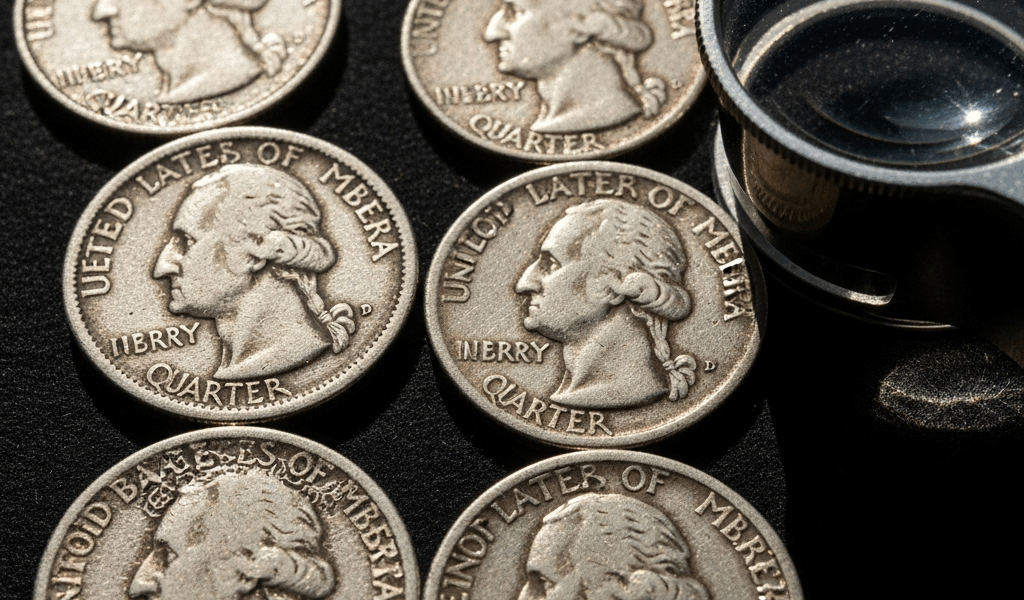
Why Barber Quarters Reward Patient Variety Hunters
Barber quarter collecting has gotten complicated with all the Morgan dollar noise flying around. As someone who spent years chasing the wrong series, I learned everything there is to know about what actually rewards patient hunters. Today, I will share it all with you.
Here’s the short version: most collectors walk right past Barber quarter varieties every single day. The series ran from 1892 to 1916 across four active mints — Philadelphia, New Orleans, San Francisco, and Denver — producing hundreds of date-mint combinations that still surface in old estate rolls and bank dumps. Hundreds of them.
But what is a Barber quarter variety, really? In essence, it’s a coin struck from a die with measurable characteristics that distinguish it from other examples of the same date. But it’s much more than that. It’s evidence. Proof of when the die was used, how it wore, and what happened inside that mint on a specific day in 1901 or 1896 or 1913. A 1901-S Barber quarter isn’t just a date. It’s a story written in metal.
That’s what makes Barber quarters endearing to us variety hunters. Everyone dismisses them as commodity coins — solid, historically respectable, but not particularly exciting. That assumption is completely wrong. So, without further ado, let’s dive in.
Mintmark Varieties That Change the Coin’s Story
Philadelphia struck Barber quarters without mintmarks. New Orleans used O. San Francisco used S. Denver came later with D. That’s the baseline everyone knows.
The New Orleans mint is where things get genuinely interesting. Some 1892-O quarters show a micro O — tiny, crisp, sitting directly below the eagle’s tail feathers on the reverse. Other examples from that same year exhibit a macro O, noticeably larger and occasionally nudged slightly off-center. This isn’t an optical trick from wear. These are real die varieties.
Frustrated by the lack of documentation in her reference books, one collector I know spent an afternoon examining rolls from an old bank liquidation — a single roll of twenty coins — and turned up three distinct 1892-O mintmark states. No monetary premium attached to any of them. Didn’t matter. That afternoon changed how she understood die preparation at the New Orleans facility entirely.
San Francisco mintmarks tell a parallel story. The 1896-S Barber quarter runs scarce in circulated grades — not impossible, but uncommon enough that finding three or four solid examples across twenty years of casual searching is honestly realistic. The S appears consistently below the eagle, but strike depth varies between early and late die states. Early strikes give you a crisp, well-defined S. Late die states reveal something shallower, sometimes weak enough that you genuinely need a loupe to confirm what you’re looking at.
Why does any of this matter? You’re learning production timelines, understanding die wear patterns, developing an eye for genuine varieties versus ordinary damage. No price premiums required. Just observation.
Key Date and Semi-Key Varieties Worth Pulling From Lots
Probably should have opened with this section, honestly.
Start with the 1901-S. Original mintage was 1.3 million coins — lower than the typical 3-million-plus years, which earns it semi-key status. In grades running from Good through Very Fine, the 1901-S stays affordable. The visual identifier is straightforward: that S mintmark positioned under the eagle on the reverse. Once you’ve held five Barber quarters, spotting it becomes automatic.
The 1913-S is a different situation entirely. Mintage dropped to 604,000 coins — the lowest in the series outside of specific New Orleans issues. A circulated 1913-S surfaces maybe once every few years from old collections and estate lots. Nothing unusual about its die characteristics. You’re hunting it on pure scarcity, full stop.
The 1896-S, though — this one surprised me. Original mintage sat at 188,039 coins. I’m apparently someone who dramatically underestimates how hard certain coins are to find in mid-grade condition, and the 1896-S works for humbling collectors while the 1901-S never quite does the same thing. Spent eighteen months hunting a Fine or Very Fine example before one finally turned up buried in a mixed lot purchase — paid $34 for the lot, which also included eleven dateless Barber dimes and a bent 1945 Mercury. Don’t make my mistake of assuming mintage numbers translate cleanly into market availability.
The 1901-O offers a different kind of hunt. New Orleans mintmark O varieties sometimes show repunching — evidence of die preparation where the punch landed multiple times, leaving a doubled or offset O. A repunched O on the 1901-O won’t command serious premium prices, but finding one transforms that coin from ordinary filler to something genuinely noteworthy. That’s hands-on collecting at its most satisfying.
The 1892-O and 1893-O represent the series’ opening years. These coins launched a design that would dominate American circulation for a quarter-century. Finding them in original rolls connects you directly to the design’s introduction — and early die states from those years can show remarkable detail even in heavily circulated examples.
How to Examine a Barber Quarter for Die Varieties
While you won’t need a professional numismatic lab setup, you will need a handful of basic tools. A loupe, decent light, and about fifteen seconds of attention per coin.
First, you should get a 10x loupe — at least if you want to actually see what you’re examining. A 5x magnification is minimalist but functional. Ten power reveals everything without requiring premium optics. I’m apparently still using a Bausch + Lomb 10x that cost twelve dollars sometime around 1993, and it performs identically today as it did then.
Start with the reverse. Position the loupe directly over the mintmark. Three things to assess: sharpness of strike, exact positioning relative to the eagle’s tail feathers, and any evidence of doubling or repunching. Sharp mintmark means early die state. Weak mintmark suggests late die state or light striking pressure. Offset mintmarks appear visibly shifted horizontally from standard position. This whole process takes fifteen seconds once the habit develops.
Move to the date next. Repunched dates appear most frequently in the 1892-O through 1896-O range — look for ghosted or doubled numerals, faint impressions from the previous punch still visible alongside the final date. Tilt the coin under direct light with your loupe at 10x. The doubling becomes obvious once you’ve seen it once before.
Check Liberty’s portrait for die cracks while you’re there. Fine lines running through the design — typically originating at high relief points and radiating outward — indicate die aging. Die cracks don’t reduce collector value, but they’re exceptional data points for understanding where that specific coin falls in the die’s lifespan.
The Cherrypickers’ Guide to Rare Die Varieties of United States Coins might be the best option, as Barber quarter variety hunting requires a systematic reference with photographs. That is because random loupe work without documentation context is slow and frustrating — the guide shows you exactly what repunching and positioning variations look like on specific dates before you start searching.
Building a Barber Quarter Type Set vs. Date Set
Two paths exist here, and neither is wrong.
The accessible approach: collect one Barber quarter representing each major mint era. One Philadelphia coin from the early years, one New Orleans piece, one San Francisco example, one Denver issue for completeness. Five to seven coins total, all findable in Fine to Very Fine grades for under $100 combined. This is variety hunting as genuine hobby entry point — low stakes, high education.
The ambitious approach: build a complete date-mint set across the full 1892–1916 span. All four mints, every year. This means eventually pursuing the 1915-D and 1916-D — both genuinely scarce in circulated grades — alongside every New Orleans and San Francisco issue. A complete set requires patience measured in years, budget flexibility measured in hundreds of dollars, and the willingness to revisit the same dealers repeatedly while waiting for specific coins to surface.
Barber quarters remain affordable relative to Barber dimes and Barber half dollars. That’s your real competitive advantage here as an intermediate collector. A respectable variety collection is buildable without the financial strain those other series demand. This new idea — that overlooked series reward the patient hunter more reliably than celebrated ones — took off several years into my collecting and eventually evolved into the systematic approach enthusiasts know and practice today.
Start with a loupe, a few rolled lots from online auction sources, and honest curiosity about what these coins reveal under magnification. That’s genuinely all you need.

Stay in the loop
Get the latest global coin collector updates delivered to your inbox.