Two Coins, Two Eras of American History
The Morgan dollar vs Peace dollar debate has gotten complicated with all the conflicting collector advice flying around. I’ve been having this argument — with myself, with strangers at coin shows, with a guy named Dale who cornered me near the Morgan display at a Baltimore show in 2019 — for about fifteen years. Both are large silver dollars. Both fill the same album slot. And yet holding one versus the other feels genuinely different, and that difference starts with where each coin came from.
This article includes affiliate links. We may earn a commission at no extra cost to you.
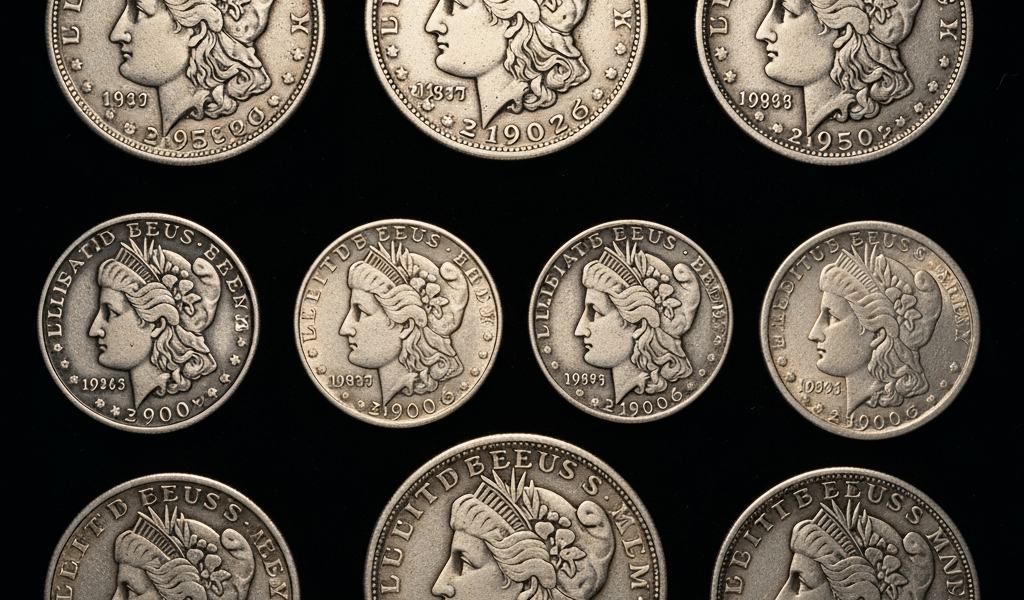
The Morgan dollar was born in 1878. Not just from some bureaucratic design process, but from Gilded Age politics — Western silver mining interests had lobbied hard for a coin that would force the government to absorb their output, and Congress delivered with the Bland-Allison Act. George T. Morgan, an English-born engraver who’d recently joined the Philadelphia Mint, won the design competition. His Liberty — modeled partly on Anna Willess Williams, a Philadelphia schoolteacher — wears a Phrygian cap and a crown of stars with a firm, almost imperious expression. The eagle on the reverse has wings spread wide, talons gripping arrows and an olive branch. It’s a coin that broadcasts confidence. Power, even.
But what is the Peace dollar, really? In essence, it’s a silver dollar minted starting in 1921. But it’s much more than that. World War I had just ended, and the emotional context couldn’t be more different from the Morgan’s origins. The American Numismatic Association and sculptor Anthony de Francisci campaigned for a new dollar design that reflected the national mood — relief, exhaustion, cautious hope. Frustrated by postwar imagery that still celebrated conflict, de Francisci sketched his Liberty facing left, sun rays radiating behind her head, using his wife Teresa as the primary model. His eagle perches rather than strikes. The word PEACE is inscribed below. These are not two versions of the same idea. They are two entirely different statements about what America thought it was.
That’s what makes the historical context endearing to us collectors. It shapes why each coin feels different when you hold it.
Design, Strike Quality, and What They Look Like in Hand
Open a Dansco Morgan album and a Dansco Peace album side by side. The visual difference hits you immediately. Morgans — especially in grades above AU-55 — develop that cartwheel luster, the spinning flash of light across the fields, in a way that photographs poorly but is absolutely magnetic in person. Wear shows first on Liberty’s cheek and the eagle’s breast. Even an MS-63 can have eye-popping originality if the surfaces haven’t been cleaned.
Peace dollars take luster differently. The high-relief design on the 1921 issue — struck for only one year before the relief was lowered — creates deep shadows and dramatic contrast. Mid-series Peace dollars, the common dates from 1922 through 1926, often show flat hair detail above Liberty’s ear. This is a known weak-strike area, not a grade issue. Collectors who don’t know to look for it end up overpaying for MS-63 coins that look soft at 5x magnification. I made exactly that mistake with a 1924-P early in my collecting — paid $52 for what turned out to be a weakly struck example that looked worse than a $38 coin I’d passed over at the same show. Don’t make my mistake.
For display purposes, both series look excellent in slabs or album windows. Morgans in MS-64 and above have a drama to them — the luster rolls, the details are crisp, and the sheer size at 38.1mm commands attention. Peace dollars at similar grades have an almost sculptural quality, especially the 1921 high relief. Art Deco in coin form, honestly.
Key Dates, Mintmarks, and Where the Depth Is
Probably should have opened with this section, honestly. The key date situation for each series tells you a lot about what kind of collector experience you’re actually signing up for.
Morgan dollars were minted from 1878 to 1904 and again in 1921. That’s 96 date-and-mintmark combinations in the standard set, plus the famous rarities. The 1893-S is the most coveted — a low-mintage San Francisco issue that in VF-20 runs $4,000 to $6,000 and in MS-63 can exceed $100,000. The 1895 Philadelphia issue was struck as a proof only, with 880 pieces produced, and no business strikes are known. It’s effectively unobtainable for most collectors and typically omitted from album goals. Below those peaks, a dozen semi-keys will test your budget in ways you won’t enjoy.
Then there’s the VAM world. VAM stands for Van Allen-Mallis, the researchers who catalogued hundreds of die varieties across the Morgan series. I’m apparently wired for variety chasing, and VAM World works for me while broader date collecting never quite scratches the same itch. Doubled dies, clashed dies, misplaced mintmarks — it’s a genuine rabbit hole with no visible bottom. The Morgan dollar variety collecting community is one of the most active in all of American numismatics.
Peace dollars are a different proposition entirely. Minted 1921 to 1928 and 1934 to 1935, the series has 24 date-and-mintmark combinations in the standard set. The keys are the 1921 high relief, the 1928 Philadelphia issue — low mintage at 360,649 coins — and the 1934-S. In circulated grades, even the 1928 is accessible. Expect to pay $200 to $350 in VF condition. Completing a full Peace dollar set in circulated grades is a realistic goal for an intermediate collector with a few years and a few thousand dollars. Completing a Morgan set in the same timeframe is not. Full stop.
One note on counterfeits: both series have them, but the 1921 Peace high relief, the 1893-S Morgan, and the 1895 Morgan proof are heavily targeted. Buy key dates only from PCGS- or NGC-certified holders. No exceptions.
Budget Reality — What Each Series Costs to Collect
So, without further ado, let’s dive into the actual numbers. For circulated examples in F-12 to VF-30, common-date Morgans run $25 to $45 per coin. Common-date Peace dollars in the same grade run $22 to $38. Similar so far. The divergence hits hard once you reach semi-key and key dates.
Filling a complete Dansco Morgan album — all dates and mints in circulated grades, excluding the 1895 proof — will cost most collectors between $8,000 and $15,000 depending on patience and sourcing skill. At AU grades, that number roughly doubles. Chasing MS-63 across the board is a multi-decade, multi-tens-of-thousands-of-dollars project. A legitimate life goal for a serious collector. Not a weekend project.
A complete Peace dollar date-and-mint set in circulated VF-EF grades runs $1,500 to $2,500 for most collectors. In AU-55, budget $3,000 to $5,000. In MS-63, a complete set will cost $6,000 to $10,000 — the 1928 and 1934-S doing most of the damage. This is a series where finishing is actually on the table. That matters more than people admit when they’re just starting out.
Which Series Is Right for You
Here’s the honest decision matrix. No hedging.
Go Morgan if:
- You want a collecting focus that will outlast your patience for other hobbies
- Die varieties and attribution work appeal to you — the VAM World website and community are outstanding resources
- You’re drawn to the Gilded Age and Western expansion history embedded in these coins
- You don’t need a finish line to stay motivated
Go Peace if:
- You want a complete set you can actually finish
- Art Deco aesthetics speak to you — the design holds up remarkably well even now
- You’re newer to collecting and want a series that rewards systematic acquisition without a decade of prerequisite knowledge
- You’re building a display focused on early 20th century American history
As someone who agonized over this exact choice for longer than I care to admit, I learned everything there is to know about talking myself in circles. Today, I will share it all with you — starting with the most useful thing I actually did. I bought one of each. A circulated 1922 Peace dollar and a circulated 1921-D Morgan, both in VF-35, both purchased for under $40 each at a local show in late 2010. I held them for a full month before committing to either series. That’s not filler advice. The tactile experience of a large silver dollar — the specific heft of 26.73 grams, the way the design engages your thumb as you rotate it — is real information your eyes on a screen simply cannot replicate.
Both coins are worth owning. One of them will become your series. Pick them up before you decide.


Stay in the loop
Get the latest global coin collector updates delivered to your inbox.