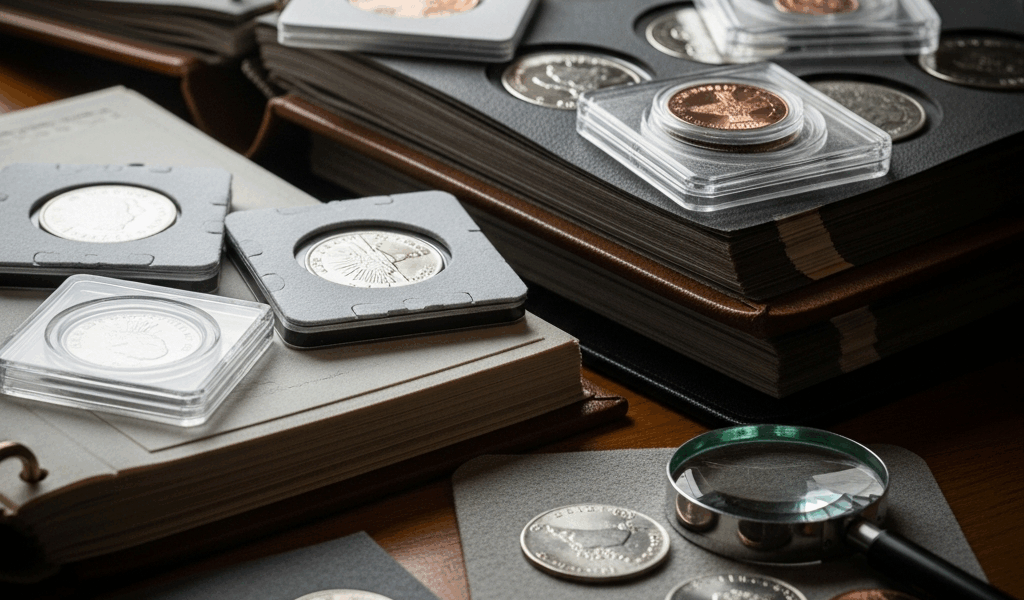
Best Coin Albums and Holders — Protecting Your Collection the Right Way
Coin storage has gotten complicated with all the cheap, misleading products flying around. As someone who’s been collecting for going on fifteen years, I learned everything there is to know about what bad holders can do to good coins — and I learned it the hard way. A 1921 Morgan dollar I’d picked up in MS-63 condition developed this greenish, waxy film on the obverse. Two years in a soft vinyl flip from a bargain bin. That coin dropped a full grade point, maybe two. The damage was permanent. So before we get into which albums are actually worth buying, we need to talk about what’s probably destroying your collection right now.
This article includes affiliate links. We may earn a commission at no extra cost to you.
The PVC Problem — Why Cheap Holders Damage Coins
But what is PVC damage, exactly? In essence, it’s what happens when plasticizers from polyvinyl chloride migrate out of flexible plastic and onto your coin’s surface. But it’s much more than that — it’s a slow, invisible process that’s already underway in a lot of collections right now.
The plasticizers manufacturers add to keep PVC soft don’t stay put. They leach out over time. When they hit silver or copper — especially silver — they leave behind a greenish, oily residue. Early stages look like a slight haze. Advanced cases look like someone dragged a green crayon across your coin. Neither stage reverses cleanly, even with professional conservation. You’re often left with altered surfaces regardless.
Here’s how you spot a PVC holder before it does damage. Soft, almost rubbery flips — the kind that bend without resistance — those are almost always PVC. Hard, rigid plastic is generally fine. It’s the soft stuff that kills coins. Some dealers still hand these out at shows because they cost about two cents each. Politely decline, or transfer the coin the minute you get home. Don’t make my mistake.
Safe alternatives use Mylar — technically biaxially-oriented polyester — polyethylene, or polypropylene. These materials don’t off-gas plasticizers. They’re inert. When buying flips or pages in bulk, look specifically for “Mylar,” “archival safe,” or “PVC-free” on the packaging. If the packaging doesn’t say anything about it, that’s your answer right there. Guardhouse and BCW both sell clearly labeled PVC-free flips. A pack of 100 Saflips from E&T Kointainer runs $12 to $15 and will last indefinitely without threatening your coins.
Best Albums for Type Collections
Album collecting — filling slots across an entire series like Lincoln cents or Mercury dimes — is one of the most satisfying formats in the hobby. It’s also where PVC concerns get genuinely complicated, because albums use cardboard slides and plastic windows that are harder to evaluate than individual flips.
Dansco
Dansco albums are the standard against which everything else gets measured. That’s what makes them endearing to us collectors — they’ve earned that reputation over decades of consistent quality. The pages use a hard, rigid vinyl that has tested safe for long-term storage, and the sliding mechanisms hold coins securely without applying the kind of pressure that causes wear. A Dansco 7070 — the flagship type set album — retails around $45 to $60 depending on vendor. Worth every dollar. Pages lie flat, labeling is clean, and the binder handles regular use without the spine cracking after two years of normal handling.
One honest caveat — Dansco albums expose both sides of the coin, which means circulating air interacts with coin surfaces. In high-humidity environments, that’s a real concern. More on that in the storage section below.
Whitman
Whitman folders are what most people start with — available at big-box hobby stores, around $5 for a Lincoln cent folder. Cardboard with circular holes, no windows, minimal protection. One side of every coin sits fully exposed. Whitman folders are fine for circulated coins you’re assembling for fun. But I wouldn’t put anything grading above AU-50 into one and expect it to look the same in ten years. The cardboard itself can transfer sulfur compounds to coin surfaces, especially under imperfect storage conditions.
Intercept Shield
Intercept Shield albums are the premium option, and they carry a premium price — a full-size album runs $80 to $120. The technology, apparently originally developed for military applications, involves a copper-impregnated polymer that actively absorbs sulfur and other reactive gases before they reach coin surfaces. For toned coins you’re trying to preserve exactly as-is, or proof sets where surface preservation is everything, Intercept Shield is genuinely worth the price difference. For a type set of circulated coins — probably overkill. For a registry-quality proof set or a complete American Silver Eagle run you’ve spent twenty years building — worth every penny.
Best Holders for Raw Coins
Probably should have opened with this section, honestly. Most collectors store the bulk of their coins as raw coins in individual holders rather than albums. Here’s what actually works.
2×2 Flips — Mylar Only
The standard 2×2 flip — small folder, holds one coin, folds in half — is everywhere at shows and in dealer inventories. The only distinction that matters is Mylar versus PVC. Saflips from E&T Kointainer are the industry benchmark. They’re stiff, crinkle slightly when you handle them, and have a matte look to them. Soft, glossy, or rubbery 2x2s are PVC. Tossed by the thousand into dealer boxes and handed out freely at shows, soft PVC flips are probably responsible for more coin damage than any other single factor in the hobby. Buy Mylar. Always.
Air-Tite Capsules
Air-Tite capsules are rigid plastic holders that fully encapsulate a coin — they come in lettered sizes, “H” for half dollars, “A” for smaller coins, and snap shut with a satisfying firm click. A pack of 25 “H” capsules runs about $18 to $22. Protection against handling, environmental exposure, and physical contact is genuinely better than any flip. The tradeoff is bulk — a hundred Air-Tites take up significantly more drawer space than a hundred flips — and cost.
For coins worth $50 and up, the protection justifies the expense. For a roll of common-date Roosevelt dimes you’re slowly working through, probably not necessary. Air-Tites also come with ring inserts in black or white foam for holding smaller coins snugly inside larger capsules — worth noting, because a 21mm coin rattling around in a 26mm capsule will develop hairlines fast.
Saflip Holders
Beyond the standard 2×2 format, Saflips also make larger holders for silver dollars and oversized coins. These remain the go-to for raw coins you’re actively trading or examining regularly — they allow handling with minimal risk, stack cleanly in boxes, and label easily with a felt-tip pen on the back panel. For long-term storage without handling, capsules are superior. For working coins, Saflips are practical and safe.
Storage Environment Matters More Than Holders
This is the part most collector guides skip — and skipping it is a real mistake. The best holders available can’t fully compensate for a bad storage environment. I know this because I stored a small collection in a basement with seasonal humidity swings for a few years. Even properly housed coins developed light haze on copper surfaces. Three years of that environment undid careful purchasing decisions.
Temperature matters, but humidity matters more. The target range for coin storage is 35% to 55% relative humidity. Above 55%, moisture accelerates toning and surface reactions on silver and copper. Below 35%, you can run into issues with certain organic materials — though coins handle dry conditions considerably better than humid ones. A decent digital hygrometer costs $12 to $20 and tells you exactly what your collection is living in right now. Buy one before you buy another holder.
Temperature swings are almost as damaging as high humidity. Rapid changes cause condensation on coin surfaces — and condensation plus air is chemistry you don’t want anywhere near your coins. Stable temperature in the 65°F to 70°F range is ideal. A climate-controlled interior room is almost always better than a basement, attic, or garage.
Silica gel packets extend shelf life significantly in enclosed storage — safes, storage boxes, that sort of thing. Rechargeable silica gel canisters from brands like Eva-dry run around $20 and handle a modest-sized safe indefinitely with periodic recharging in an oven. That’s a better investment than most people realize, honestly.
Handling is the final environmental factor. Cotton gloves are the standard advice, though some experienced collectors handle coins by the edge with clean, dry fingers — the argument being that gloves can snag and cause their own problems. Either way, never touch the fields or devices. Skin oils etch into coin surfaces over time, and a fingerprint on a proof coin is a slow-motion disaster that won’t fully reveal itself for years.
When to Send Coins for Professional Encapsulation
NGC and PCGS slabs — the hard plastic holders used by the two major grading services — offer the best individual protection available. Sonically sealed, inert, tamper-evident. The problem is cost. Submitting to PCGS or NGC through standard tier currently runs $30 to $65 per coin depending on value and service level, plus shipping and insurance both ways. The math only works in specific situations.
Submit for encapsulation when a coin’s value in a holder would meaningfully exceed its raw value plus submission cost. A key-date coin worth $300 raw might grade MS-64 in a slab and sell for $450 — that math works. A $40 common-date silver dollar probably won’t grade high enough to justify $50 in fees. Submit coins you plan to sell at their highest value, where a certified grade removes buyer skepticism. Submit coins you genuinely can’t store safely otherwise — ultra-high-relief pieces with delicate surfaces, for instance, that are nearly impossible to handle without risk.
One thing slabs don’t do — they don’t stop long-term environmental damage if the holder itself is compromised. A cracked slab isn’t protecting anything. Resubmit immediately if you find one.
The bottom line is that coin storage is a series of layered decisions, not a single product purchase. Start with PVC-free holders. Control your environment. Match the level of protection to the value and significance of each coin. And spend five minutes actually looking at what your coins are sitting in right now — because a lot of collections have problems hiding in plain sight inside a soft vinyl flip that should have been thrown away the day it arrived.

Stay in the loop
Get the latest global coin collector updates delivered to your inbox.