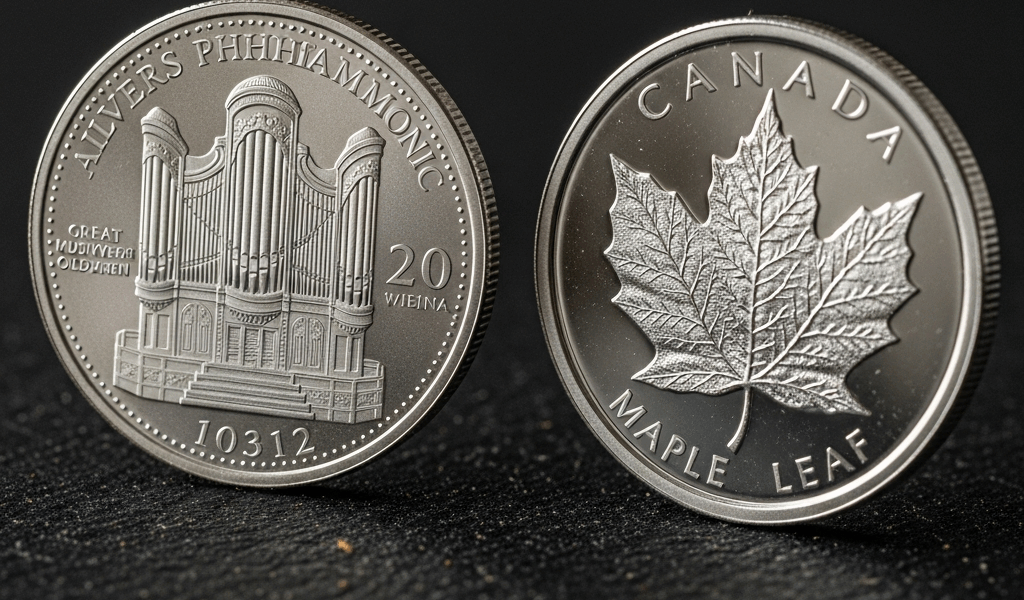
Two of the most popular silver bullion coins in the world — the Austrian Silver Philharmonic and the Canadian Silver Maple Leaf — sit side by side in dealer cases at nearly identical prices. Both contain one troy ounce of .999 fine silver. Both are government-issued legal tender. The differences are in the details that matter to collectors who care about more than just silver weight.
Purity and Specifications
The Maple Leaf is 99.99% pure silver — four nines fine, a purity level almost no other silver coin matches. The Philharmonic is 99.9% pure — three nines fine, which is the standard for most government-issued silver bullion. Both contain exactly one troy ounce of silver, weigh 31.1 grams, and are struck in .999+ silver.
Does the extra nine matter? For most collectors, no. The difference between 99.9% and 99.99% silver is negligible in terms of value, appearance, or resale. The Maple Leaf’s purity is a marketing distinction that the Royal Canadian Mint uses effectively — but it does not change the trading price meaningfully. Both coins trade at the same narrow premiums over spot silver.
Design and Visual Appeal
The Philharmonic features the instruments of the Vienna Philharmonic Orchestra — a cello, four violins, a Vienna horn, a harp, and a bassoon on the reverse, with the Great Organ from the Musikverein concert hall on the obverse. It is the only major bullion coin with a musical theme, and the design has remained unchanged since the coin’s introduction in 2008 (silver version). The intricate instrument detail makes it one of the most visually distinctive bullion coins in production.
The Maple Leaf features the iconic maple leaf on the reverse with micro-engraved security details and radial lines that catch light distinctively. The obverse carries the reigning monarch’s portrait. The design is clean and recognizable worldwide. Since 2014, the security features have been enhanced with the Royal Canadian Mint’s Bullion DNA program — a micro-engraved privy mark on each coin that dealers can verify electronically.
Premium and Market Liquidity
Both coins trade at similar premiums — typically $2 to $4 over spot silver per ounce from major dealers, depending on market conditions and order size. The Maple Leaf sometimes trades at a marginally higher premium due to its purity distinction and security features. The Philharmonic occasionally trades at lower premiums, making it a slightly better value for pure silver accumulation.
Liquidity is global for both. Every major dealer buys and sells both coins at competitive spreads. The Maple Leaf has a stronger presence in North American markets. The Philharmonic dominates European markets and is the best-selling silver bullion coin in Europe. In Asian markets, both are recognized though the Maple Leaf has marginally better recognition.
Security and Anti-Counterfeiting
The Maple Leaf wins on security. The Bullion DNA program, micro-engraved maple leaf privy mark, and precision radial line background make it one of the hardest bullion coins to counterfeit convincingly. Dealers with RCM-supplied readers can verify authenticity electronically in seconds.
The Philharmonic relies on traditional anti-counterfeiting measures — precise weight, dimensions, and the intricate musical instrument design that is difficult to reproduce at the detail level the Austrian Mint achieves. No embedded electronic verification system comparable to Bullion DNA.
The Collector’s Choice
Buy the Philharmonic if you appreciate the unique musical design, collect European-issued coins, or want the slightly lower premium for silver accumulation. Buy the Maple Leaf if security verification matters to you, you prefer the higher purity specification, or your collection leans North American. Both are outstanding silver coins from major world mints. A collection with both tells a more complete story of modern silver bullion than either coin alone.



Stay in the loop
Get the latest global coin collector updates delivered to your inbox.